Total Biosynthesis of Pseudomonas aeruginosa-Derived Azabicyclocarbamates Identifies Distinct Dehydrating Condensation Family Proteins

Total Biosynthesis of Pseudomonas aeruginosa-Derived Azabicyclocarbamates Identifies Distinct Dehydrating Condensation Family Proteins
Liu, X.; Najah, S.; Calderari, A.; Hong, Z.; Halary, S.; Lombard, C.; Bolard, A.; Jeannot, K.; Gruez, A.; Weissman, K. J.; LI, Y.
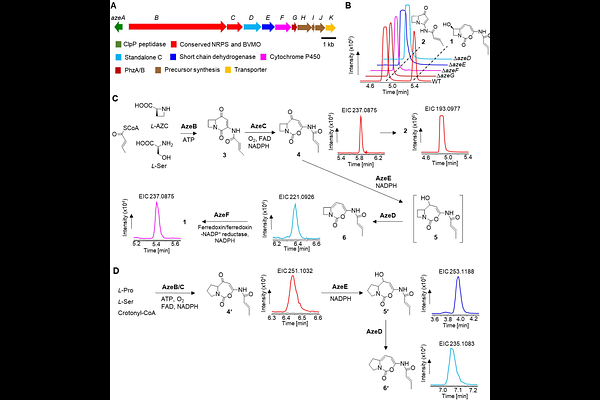
AbstractBacterial azabicyclocarbamates and related pyrrolizidine alkaloids play important roles in microbial interactions, and are scaffolds of therapeutic potential. Their biosynthesis involves a bimodular non-ribosomal peptide synthetase (NRPS), as well as a Baeyer-Villiger monooxygenase and tailoring enzymes, the latter contributing to the structural diversification of these compounds. Azetidomonamide A, a core metabolite produced by the major human opportunistic pathogen Pseudomonas aeruginosa, is a rare 4,7-bicyclocarbamate involved in modulating bacterial virulence that belongs to a unique family of natural products targeting ClpP proteases. In this study, we elucidated the full set of reactions leading to the 7-membered cyclocarbamate warhead, and reconstituted in vitro the biosynthesis of azetidomonamide A. Notably, this approach allowed for detailed characterization of a condensation (C) domain-catalyzed online dehydration via chemical capture of NRPS-tethered intermediates. Furthermore, we identified the dehydratase AzeD as the founding member of a distinct group of standalone proteins of the C domain family. Via combined structural, docking and biochemical analyses, we provided evidence that the catalytic mechanism of AzeD is distinct from that of dehydrating C domains, further expanding the known chemistry of these key biosynthetic enzymes.