Variational Autoencoder-enabled High-throughput Drug Screening for HIV Latency Modulators predicted through Noise in Gene Expression

Variational Autoencoder-enabled High-throughput Drug Screening for HIV Latency Modulators predicted through Noise in Gene Expression
Shukla, D.; Lu, Y.; Horne, J. R.; Mi, X.; Nag, S.; Dash, S.; Dar, R. D.
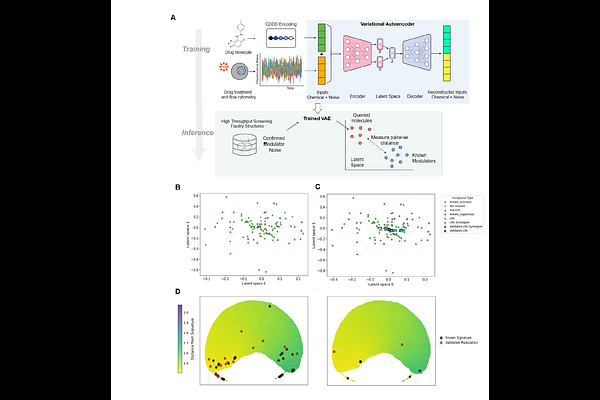
AbstractDue to its ability to establish a pool of undetectable and latently infected cells that can initiate viral production through random reactivation, a cure to human immunodeficiency virus (HIV) infections has remained elusive. Many approaches have been proposed, including the "shock and kill" method where latency reversing agents (LRAs) are administered to reactivate latently infected cells out of latency and remove them through immune targeting and clearance, and the "block and lock" method where latency promoting agents (LPAs) are administered to inhibit reactivation and potentially induce a "deep latency" state where infected cells can no longer reactivate. Previous large scale drug screen studies have demonstrated a correlation between a compound's capability to modulate the fluctuations (or "noise") in HIV gene expression and its potential to modulate HIV latency. However, measurements of gene expression noise are labor- and cost-intensive. To circumvent these drawbacks, we trained a variational autoencoder (VAE) on a previously published large scale time-lapse fluorescence microscopy dataset, and performed an in silico screening of ~175,000 compounds for HIV latency modulators. Out of the top 113 predicted modulators that were experimentally tested, 16 latency reversing agent (LRA) synergizers and 2 latency promoting agents (LPAs) were confirmed, yielding an overall experimental hit rate of 15.9%. Our work demonstrates that in silico drug screening modalities, guided by existing large-scale experimental datasets, can yield high experimental hit rates, reducing costs incurred from labor-intensive wet lab-focused methodologies.