Transposon end recognition and pairing by I-F3 CRISPR-associated transposase

Transposon end recognition and pairing by I-F3 CRISPR-associated transposase
Truong, V.; Miller, D.; Fatma, S.; Sheng, Y.; Pindi, C.; Ahsan, M.; Palermo, G.; Kellogg, E. H.
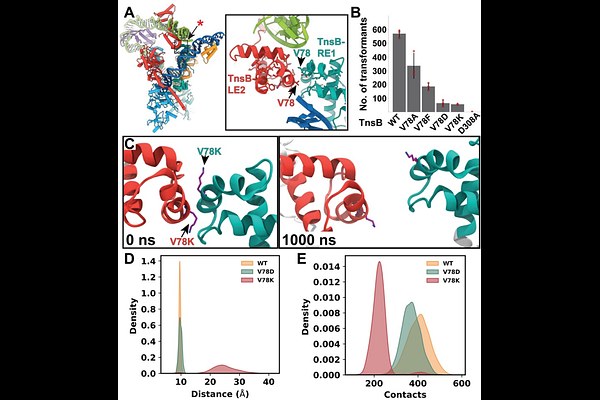
AbstractTo develop gene therapy tools based on CRISPR-associated transposons (CASTs), it is essential to define how transposon ends are recognized and paired during transposition. Tn7-like transposons typically contain asymmetric left- and right-end sequences that flank and define DNA cargo. However, how the transposase recognizes these different sequences and assembles them into a paired end complex for cut-and-paste transposition remains unknown. Here we present the cryo-EM structure of type I-F3 (VchCAST) CAST transposase TnsB in complex with transposon DNA ends and host factor IHF, along with biochemistry, molecular dynamics, and in vivo analyses. Our structure reveals the stoichiometry and architecture of the assembly, as well as the DNA distortions required to accommodate transposon end asymmetry. Molecular dynamics suggests that these distortions are required for the coordinated assembly of the complex. Physical pairing of asymmetric left and right ends results in a novel protein-protein interface that is required for transposition efficiency. Our findings explain how transposases regulate the pairing of transposon end sequences for high-fidelity recognition, reveal a model of transposon end synapsis, and suggest future avenues to engineer DNA cargo for genome-editing applications.