Spatial pattern formation as a consequence of Protease Competition

Spatial pattern formation as a consequence of Protease Competition
Chakraborty, P.; Dey, S.; Kundu, R.; Banerjee, M.; Ghosh, S.
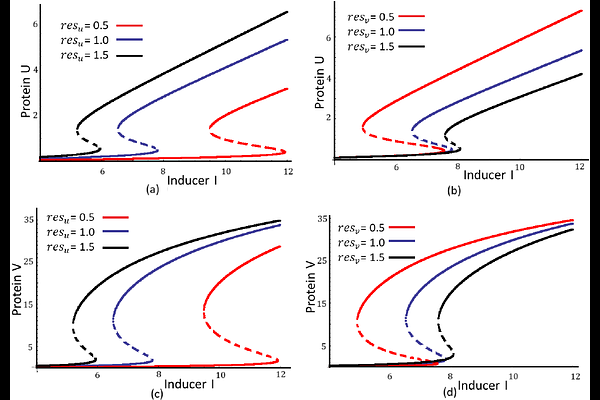
AbstractExploring the emergence of spatio-temporal patterns due to nonlinearities in gene expression is a relatively new development. In this work, we explore the effect of resource constraint on gene regulatory motif from both equilibrium and spatio-temporal standpoint, taking into consideration the degradation class of resource, protease. We have demonstrated that protease-tagged degradation can cause an emergent bistability to form in the system in a steady-state scenario. Instead of a graded linear response in protein synthesis, two Saddle-node bifurcations caused by protease competition provide a switch-like response with hysteresis, where two drastically differing protein concentrations can coexist. We next turn our attention to spatio-temporal analysis: we extend our study for a two-dimensional sheet of cells with diffusible protein molecules and report the stationary patterns. To investigate the reasons behind these non-homogeneous stationary patterns, we investigate the traveling wave solution and observe that a stationary pattern is formed by the traveling wave solution. Considering that proteases play a major role in the regulation and expression of genes in a variety of diseased scenarios, the repercussions of this spatial patterning caused by protease competition can be extensive in gene regulatory systems.