Validation of a high throughput fluorescent Capillary Electrophoresis Sodium Dodecyl Sulfate method for monoclonal antibody size heterogeneity assessment

Validation of a high throughput fluorescent Capillary Electrophoresis Sodium Dodecyl Sulfate method for monoclonal antibody size heterogeneity assessment
Luttgeharm, K. D.; Grover, M.; Huang, S.-Y.; Pike, W. A.
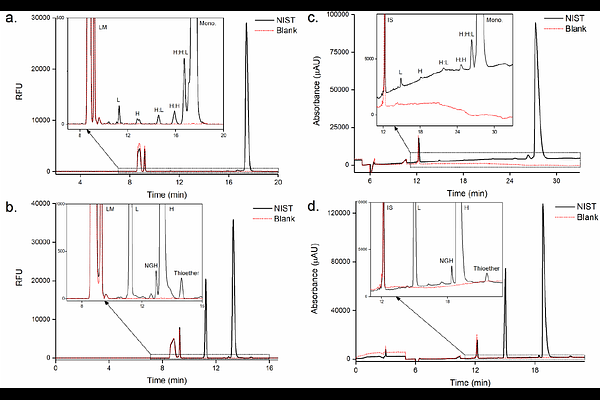
AbstractFluorescent capillary gel electrophoresis (CGE) with sodium dodecyl sulfate (CE SDS) provides a powerful, high sensitivity alternative to ultraviolet (UV) based detection for characterizing therapeutic monoclonal antibodies (mAb). Regulatory and standards organizations, such as the United States Pharmacopeia (USP), include only UV based CE-SDS methods, hindering adoption, of alternative detection methods. There is growing opportunity to expand beyond exclusively UV based CE SDS methods. In this study, we present a full analytical validation of a light-emitting diode (LED) fluorescence-based parallel CE SDS method for both non reduced and reduced analysis of therapeutic antibodies. Using the NISTmAb reference material as a model system, size heterogeneity critical quality attributes (CQAs) including monomeric purity, percent glycosylation, and percent thioether were assessed. The fluorescence method demonstrated high specificity and precision with relative standard deviation (RSD) values <1% for monomeric purity and glycosylation, and <3% for thioether), as well as robust performance across variations in injection voltage, electrophoresis voltage, labeling temperature, and Labeling Buffer concentration. Ruggedness testing across users and reagent lots confirmed reproducibility, and accuracy assessments showed strong agreement with reported values from the National Institute of Standards (NIST) and traditional UV detection measurements. Linearity studies yielded coefficient of determination values >0.995 for both non reduced and reduced analyses. These results highlight the high sensitivity, stable baseline performance, and suitability of LED fluorescence-based parallel CE SDS as a validated, higher throughput alternative to traditional UV based methods for mAb quality control (QC).