Sexual selection purges mutation load, but not overall genetic diversity in populations, decreasing vulnerability to extinction

Sexual selection purges mutation load, but not overall genetic diversity in populations, decreasing vulnerability to extinction
Pointer, M. D.; Nash, W. J.; Chapman, T.; Maklakov, A. A.; Richardson, D. S.
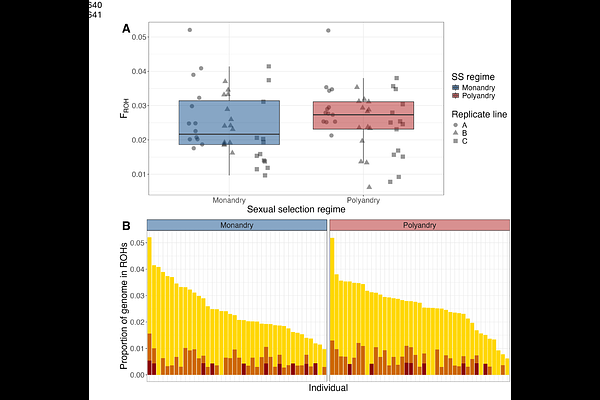
AbstractTheory suggests sexual selection will enhance population viability by purging deleterious alleles. However, direct genomic evidence for this fundamental idea is scarce and contradictory. We combined long-term experimental evolution with whole-genome re-sequencing to directly test how sexual selection affects mutation load, genomic divergence and extinction risk in Tribolium castaneum. After 156 generations, populations evolving under strong sexual selection carried substantially fewer deleterious alleles than populations under weak sexual selection, based on both individual-level estimates of missense and nonsense variants and population-level Rxy analyses, indicating more efficient purging of deleterious alleles. In contrast, nucleotide diversity and runs of homozygosity were similar across treatments, indicating that purging was targeted at deleterious variation, and that reduced mutation load in populations under strong sexual selection was not explained by demographic effects. Importantly, population-level mutation load estimates provided best explained extinction risk under inbreeding, directly linking sexual selection to purging and population viability for the first time. Genome scans of high and low sexual selection populations revealed peaks of divergence, enriched for genes involved in courtship, sex discrimination, and seminal fluid proteins. Our results provide direct genomic evidence that sexual selection can reduce mutation load without eroding standing genetic diversity and thus adaptive potential, while driving adaptive divergence in reproductive traits. This beneficial purging may help explain the widespread prevalence of sexual reproduction in nature despite inherent costs and have important ramifications as to how we manage populations of conservation concern.