Plasticity of the mutation rate and spectrum in eukaryotic marine phytoplankton

Plasticity of the mutation rate and spectrum in eukaryotic marine phytoplankton
Mettrop, L. A. I.; Lipzen, A.; Vandecasteele, C.; Eche, C.; Sanchez, F.; Labecot, A.; Manirakiza, E.; Barry, K.; Grigoriev, I. V.; Piganeau, G.; Krasovec, M.
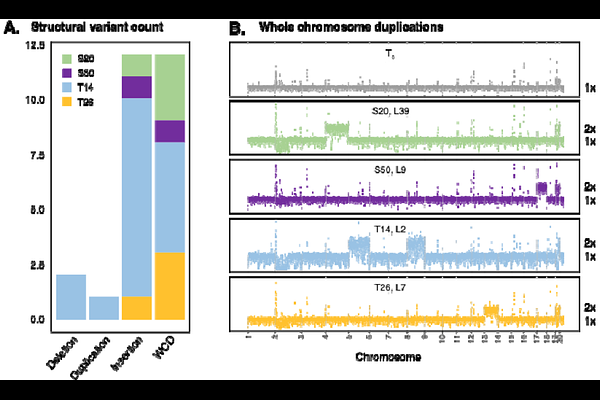
AbstractThe ability to adapt shapes the future of any species or population. Adaptive potential is primarily determined by the spontaneous mutation rate and the mutation spectrum, which define the new genetic variation available to selection. Increasing evidence points to the plasticity of the mutation rate and spectrum, which vary according to environment. However, data is lacking for marine phytoplankton, an essential group for marine ecosystems as well as a major player in biogeochemical cycles. Here, we measure the plasticity of mutation rates and spectra in the chlorophyte Ostreococcus tauri by mutation accumulation experiments in 4 different conditions: low salinity, high salinity, low temperature, and high temperature. SNM is lowest under low salinity, doubles under high salinity and low temperature and quadruples under high temperature. SNM spectra become increasingly biased towards C:G->T:A transitions with increasing SNM. While ID does not change with the environment, the structural mutation rate SM is higher at low temperature, likely due to transposon activity. Given the rapid environmental changes associated with global climate change, mutation rates and spectra plasticity may critically influence the adaptive potential of marine primary producers.