Munc18 reprograms the intrinsic neuronal SNARE complex assembly pathway

Munc18 reprograms the intrinsic neuronal SNARE complex assembly pathway
Vishvakarma, V.; Chapman, E. R.
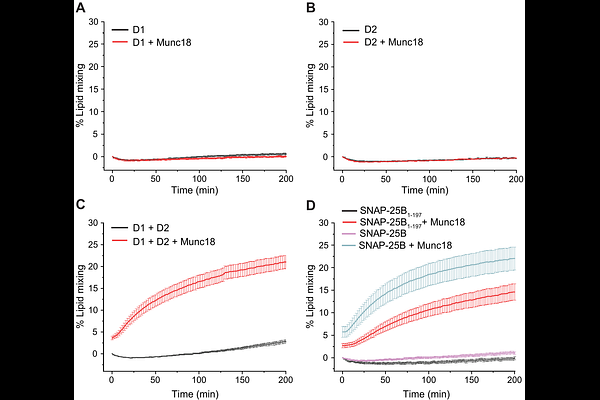
AbstractThe SNARE proteins syntaxin/SNAP-25B (t-SNAREs) and synaptobrevin (v-SNARE) contain motifs that assemble into four-helix bundles to drive synaptic vesicle exocytosis; SNAP-25B contributes two helices, D1 and D2. The sequence in which these motifs interact remains unresolved. To address this, we used fluorescence anisotropy of SNARE motifs to conduct real-time order-of-addition experiments and found that the order in which components are mixed can determine whether on- or off-pathway complexes are formed. Beginning with soluble SNARE fragments alone, the first step in assembly is the binding of D1 to syntaxin, followed by the binding of synaptobrevin and D2, where the latter motif acts as a gatekeeper to control v-SNARE[middot]t-SNARE interactions. We then examined the impact of two regulatory factors, Munc18 and the MUN domain of Munc13-1. Strikingly, in the presence of Munc18, all four isolated SNARE motifs must be present at the same time for assembly to occur, revealing a concerted mechanism, while the Munc13-1 fragment was without effect. We created C-SCORE, which reports assembly of the two SNARE motifs of SNAP-25B via FRET, and confirmed that in the presence of Munc18, SNARE assembly becomes concerted. Munc18 also disaggregated syntaxin, potentially contributing to its activation. Finally, our findings regarding SNARE motif folding were well-correlated with function using full-length SNAREs in in vitro lipid mixing assays. Hence, Munc18 acts as a molecular chaperone that directly promotes the concurrent assembly of SNARE proteins into functional fusion machines.