AI predictions and the expansion of scientific frontiers: Evidence from structural biology

AI predictions and the expansion of scientific frontiers: Evidence from structural biology
Sun, M.; Choi, S.; Yin, Y.
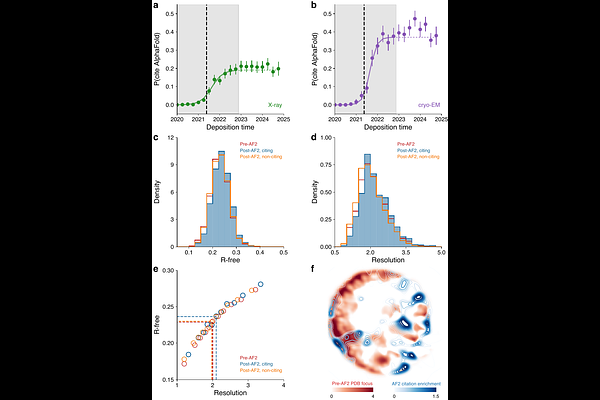
AbstractArtificial intelligence holds the potential to expand the frontier of scientific research, yet recent work has raised concern that it may instead narrow scientific attention to well-established areas. Here, leveraging the 2021 release of AlphaFold2 as a quasi-experimental opportunity, we provide field-level evidence that AI can redirect collective attention toward more novel research targets. Tracking 245,396 experimental structures in the Protein Data Bank, we show that a long-running decline in the study of novel proteins halted after AlphaFold2's release, with the shift concentrated among studies citing AlphaFold2 and targets with high-confidence predictions. This pattern extends to 248,191 downstream papers that consume structural knowledge, where engagement with genes lacking experimental structures and with understudied human genes increased since 2021. Amid rising concern that AI may reinforce scientific canons, our findings offer an early field-level case where AI predictions expand scientific frontiers, consistent with the idea that the real-world consequences of AI on science depend on where their informational gains are greatest. These results suggest AI can complement human knowledge and redirect collective attention in science, with broad implications for emerging AI for science models.