Assessing the Operational Feasibility of Evolutionary Therapy in Metastatic Non-Small Cell Lung Cancer

Assessing the Operational Feasibility of Evolutionary Therapy in Metastatic Non-Small Cell Lung Cancer
Soboleva, A.; Honasoge, K. S.; Molnarova, E.; Dingemans, A.-M.; Grossmann, I.; Rezaei, J.; Stankova, K.
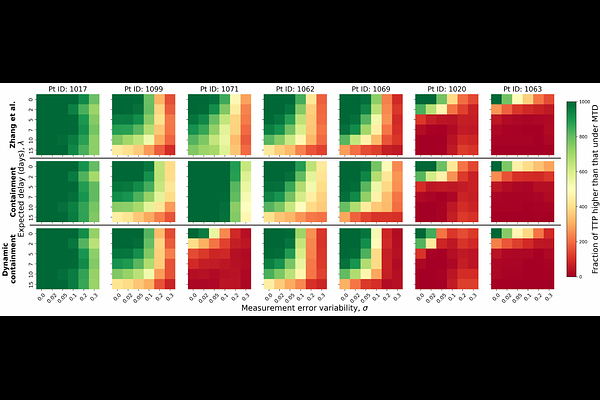
AbstractEvolutionary cancer therapy (ECT) applies principles of evolutionary game theory to prolong the effectiveness of cancer treatment by curbing the development of treatment resistance. It was shown to increase time to progression while decreasing the cumulative drug dose. ECT individually tailors treatment schedules for patients based on their cancer dynamics and, thus, requires regular follow-up and precise measurements of the cancer burden. The current literature on ECT often overlooks clinical realities, such as rather long intervals between tests, possible appointment delays and measurement errors, in the development of the treatment protocols. In this study, we assess the clinical feasibility of ECT for metastatic non-small cell lung cancer (NSCLC). We create virtual patients with cancer dynamics described by the polymorphic Gompertzian model, based on data from the START-TKI clinical trial. We assess the effects of longer test intervals, measurement error and appointment delays on the expected time to progression under the evolutionary therapy protocols. We show that a higher containment level, although it increases time to progression in the model's predictions, may lead to premature treatment failure in the presence of measurement error and appointment delay. Further, we show that the ECT protocol with a single containment bound is more robust to the clinical realities than the protocol with two bounds. Finally, we show that a dynamically adjusted treatment protocol can be beneficial for individual patients, but requires a thorough follow-up. This study contributes to the design of a clinical trial and the future clinical implementation of evolutionary therapy for NSCLC.