An NAMPT Inhibitor Decreases NAMPT Capture by an Antibody Directed against the 5-Phosphoribosyl-1-Pyrophosphate-Binding Loop: A Rational for an NAMPT Occupancy Assay

An NAMPT Inhibitor Decreases NAMPT Capture by an Antibody Directed against the 5-Phosphoribosyl-1-Pyrophosphate-Binding Loop: A Rational for an NAMPT Occupancy Assay
Shomali, M.; Hilairet, S.; Duhamel, M.; Nardi, F.; Bertrand, T.; Mathieu, M.; Arrebola, R.; Penarier, G.; Jegham, S.; Arigon, J.; Cosnier, S.; bouaboula, M.
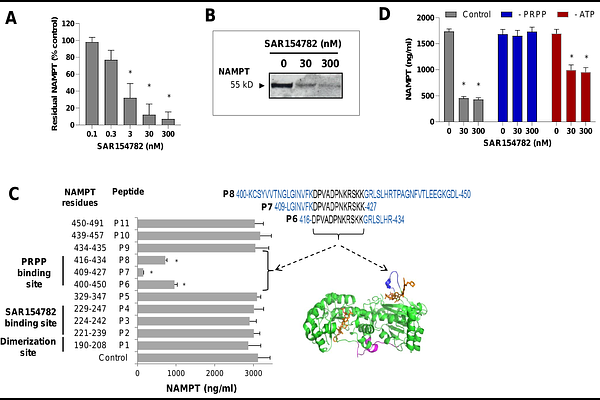
AbstractNicotinamide phosphoribosyltransferase (NAMPT) catalyzes the rate-limiting step of nicotinamide adenine dinucleotide (NAD) biosynthesis. NAMPT inhibitors (NAMPTi) have been shown to be NAMPT substrates. The resulting NAMPTi-phosphoribose (RP) adduct binds tightly to NAMPT and inhibits the enzyme. Using new NAMPTi, SAR154782, structural analyses performed in this study unveiled a close proximity of the SAR154782-RP complex to the 5-phosphoribosyl-1-pyrophosphate-binding (PRPP-binding) loop within the NAMPT catalytic site. The PRPP-binding loop of NAMPT is subject to conformational flexibility. Interestingly, the PRPP-binding loop domain is oriented to the outer side of the NAMPT dimer and can potentially serve as an antigen-binding site for antibodies. Here we report for the first time that the NAMPTi-RP adduct bound to NAMPT decreases NAMPT capture by an antibody directed against the c-terminal PRPP-binding loop in NAMPT. This finding was then used to explore cellular NAMPT occupancy. The NAMPTi-RP complex displays a sustained, cellular NAMPT occupancy that correlates with the inhibition of NAMPT activity. Moreover, a good correlation between NAMPT occupancy, NAD decrease, and NAMPTi efficacy was observed in-vivo in a NCI-H82 small cell lung cancer (SCLC) xenograft model. NAMPT-occupancy assay can be used in clinical settings to better define the optimal dose levels and dose regimen for effective NAMPT inhibition.