Bioinformatics Analysis of Non-Coding UTR Variants in STAT1 Reveals Disruption of miRNA Binding, mRNA Stability, and Oncogenic Potential

Bioinformatics Analysis of Non-Coding UTR Variants in STAT1 Reveals Disruption of miRNA Binding, mRNA Stability, and Oncogenic Potential
Kamal, E.; Ahmed, M.
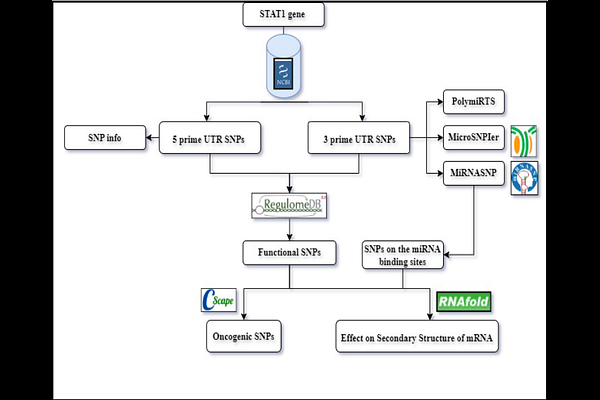
AbstractSingle nucleotide polymorphisms (SNPs) are associated with a wide range of disorders, including diverse cancer types. In the context of cancer, alterations within non-coding regions, specifically untranslated regions (UTRs), have proven substantially important. SNPs localized in the 3 prime UTRs of the STAT1 gene were assessed for their association with miRNAs using PolymiRTS, miRNASNP, and MicroSNIper. In addition, the 5 UTR SNPs were analyzed by SNP INFO for changes in the transcription binding sites. The significant SNPs were further analysed by Cscape to predict their oncogenic probability. The secondary structures of the wild type and the mutant mRNA were analysed by RNAfold. Out of 605 SNPs analyzed, 14 UTR SNPs (six in the 3\' UTR region and eight in the 5\' UTR region) were identified as [≤]2a by RegulomeDB. The associations of 8 SNPs with miRNAs common between the 3 databases were found. The 3\' UTR SNPs rs1197872838 and rs3088307, the 5\' UTR region variants rs45470392, rs1413522785, and rs531009254, Out of the 8 SNPs that are associated with miRNA and commonly identified by the 3 databases (PolymiRTS, miRNASNP, and MicroSNIper), only one SNP (rs190508584) was predicted to destabilize the mRNA structure resulting in substantial change in free energy ({triangleup}G). The SNP rs45470392 in 5\' UTR was predicted to alter the transcription factor binding sites. rs188557905, rs1220766131, rs1413522785, rs1168, and rs999207177 were predicted to be oncogenic SNPs in this study using bioinformatics tools. Our findings highlight the impact of 3\' and 5\' UTR SNPs on miRNA, transcription, and translation of STAT1. These analyses suggest that these SNPs can have substantial functional importance in the STAT1 gene. Future experimental validation could establish their potential role in the diagnosis and therapeutics of various diseases, including cancer. Keywords: SNP, non-coding region, 3\' UTR, 5\' UTR; STAT1, miRNA, Bioinformatics