Evolution of compound eye cell types shapes visual behaviors across Heliconius butterflies

Evolution of compound eye cell types shapes visual behaviors across Heliconius butterflies
Lu, W.; VanKuren, N. W.; Catalano, C.; Levine, M. S.; Wallsten, C.; Kronforst, M. R.
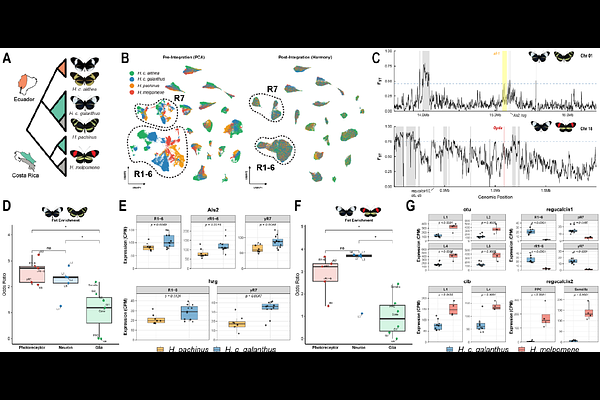
AbstractThe evolution of visual systems is tightly linked to the diversification of visually guided behaviors. Using Heliconius butterflies, renowned for their rapid diversification of wing color patterns and corresponding visual mate preferences, we investigate the evolution of compound eye cell types across a complete speciation continuum. By integrating population genomics, chromatin conformation capture, and single-nucleus multi-omics, we uncover multi-modal mechanisms driving visual system evolution. Within a population polymorphic for mate preference, we identify senseless-2 as a glia-expressing candidate visual preference gene. Across species, we reveal that photoreceptors, particularly the color-sensing R7s, are the fastest-evolving cell types. Furthermore, we molecularly characterize novel R2/5 and R7 photoreceptor subtypes, showing that cellular subfunctionalization arises through the co-option of existing gene regulatory networks. Together, this comparative single-cell analysis of compound eyes bridges microevolutionary transcriptomic divergence with macroevolutionary cellular innovations.