Modeling the Role of Platelet-Released Polyphosphates in Tissue-Factor-Initiated Coagulation under Flow

Modeling the Role of Platelet-Released Polyphosphates in Tissue-Factor-Initiated Coagulation under Flow
Ramesh Bhatt, S.; Ginsberg, A. G.; Smith, S. A.; Morrissey, J. H.; Fogelson, A. L.
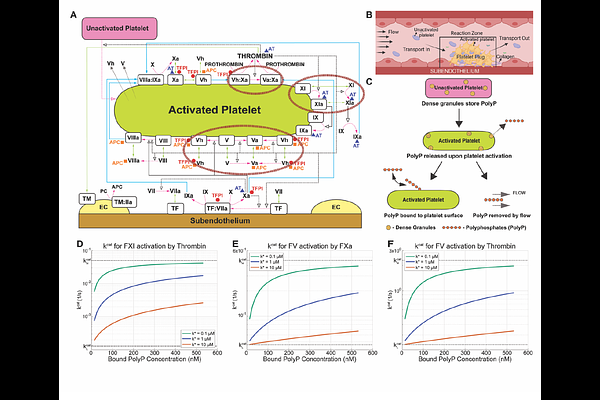
AbstractBackground: Activated platelets release polyphosphate (polyP), a linear polymer of inorganic phosphate residues, from dense granules. Experiments performed under no-flow conditions show that polyP alters the kinetics of tissue factor (TF) pathway reactions, accelerating FXI activation by thrombin and FV activation by FXa and thrombin, and may impact inhibition by tissue factor pathway inhibitor (TFPI). How polyP influences this pathway in conjunction with platelet deposition under flow remains understudied. Objectives: To investigate how polyP-mediated acceleration of FV and FXI activation modulates thrombin generation under flow in TF-initiated coagulation. Methods: We extended a previously validated mathematical model of platelet deposition and coagulation under flow to examine polyP-mediated effects following a small vascular injury during intravascular clotting. Simulations varied the surface density of TF exposed, wall shear rate, and plasma TFPI concentration. Results: PolyP shifts the threshold TF density for a thrombin burst to lower TF densities. For TF densities above this threshold, polyP shortens the lag time to thrombin generation in a TF- and shear-rate-dependent manner. Although no explicit effect of polyP on TFPI function was included in the model, thrombin generation was much less sensitive to TFPI concentration with polyP, in a TF-dependent manner. Relative contributions of accelerations of FV and FXI activations depend on incompletely known enhancements by polyP. Conclusions: The experimentally observed influence of polyP on TFPI function depends on TF density and may arise indirectly from accelerated FV and FXI activation, with the dominant effect arising through accelerated thrombin-mediated conversion of FV to FVa.