Quinolinic acid phosphoribosyl transferase moonlights as an apoptosis regulator to empower lung cancer progression

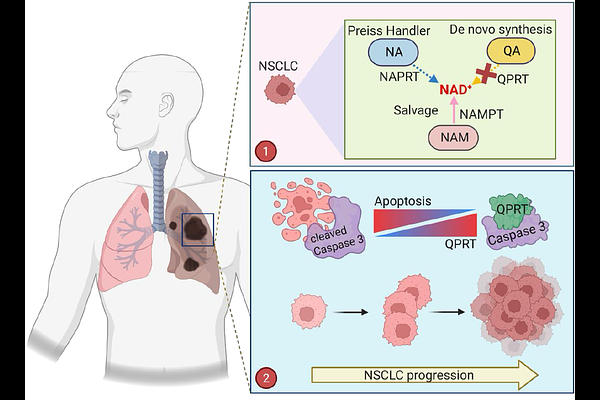
Quinolinic acid phosphoribosyl transferase moonlights as an apoptosis regulator to empower lung cancer progression
Kashfi, H.; Ilter, D.; Nicolaci, A.; Lockhart, J.; Drapela, S.; Lazure, F.; Raizada, D.; Sarigul, N.; Spegel, J.; Ward, N.; Dutta, T.; Gardell, S.; Binning, J.; Flores, E.; DeNicola, G. M.; Gomes, A. P.
AbstractAlthough nicotinamide adenine dinucleotide (NAD) metabolism is fundamental for cancer cell survival, the role of the de novo NAD biosynthetic pathway, particularly in non-small cell lung cancer (NSCLC), remains largely unknown. Here, we describe a non-canonical role for the rate-limiting enzyme in de novo NAD+ biosynthesis, quinolinate phosphoribosyltransferase (QPRT), in NSCLC progression. We show that QPRT is highly expressed in late-stage tumors and required for NSCLC growth; however, its suppression does not change NAD levels or elicit compensatory NAD biosynthetic activity. Instead, QPRT interacts with caspase-3 and suppresses its activation, protecting NSCLC cells from apoptosis. This reveals a moonlighting function for QPRT in apoptosis regulation independent of its enzymatic activity in tryptophan catabolism. Together, these findings, redefine QPRT as a protein with dual functionality and reveal it as a potential therapeutic target in NSCLC, highlighting the importance of non-canonical roles of metabolic enzymes in cancer biology.