Endothelial β3-Adrenergic Receptor activation prevents pulmonary hypertension

Endothelial β3-Adrenergic Receptor activation prevents pulmonary hypertension
Rocha, S. F.; de la Bastida-Casero, L.; Spaczynska-Kwiatkowska, M.; Macias, A.; Sierra-Palomares, Y.; Gomez, M.; Diaz-Guerra, A.; Villalba-Orero, M.; Peinado, V. I.; Garcia-Alvarez, A.; Barbera, J. A.; Fuster, V.; Ibanez, B.; Oliver, E.
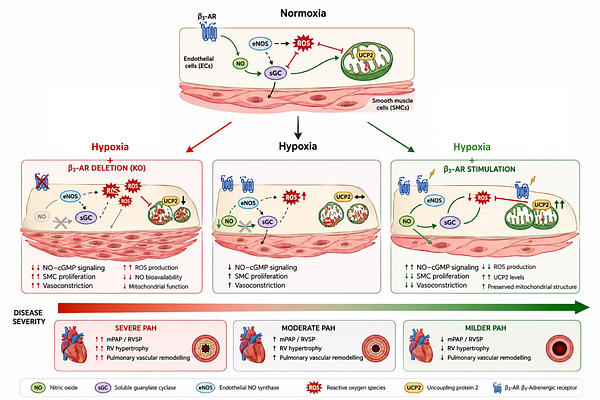
AbstractBackground: Pulmonary hypertension (PH) is a progressive vascular disease characterized by endothelial dysfunction, vascular remodeling and increased pulmonary vascular resistance. The {beta}3-adrenergic receptor ({beta}3-AR) has been implicated in cardiovascular regulation and cardioprotective mechanisms; however, its role in pulmonary vascular disease remains poorly understood. We investigated whether activation of {beta}3-AR protects pulmonary endothelial function and prevents the development of pre-capillary PH. Methods: {beta}3-AR expression was evaluated in pulmonary endothelium from patients with Chronic Obstructive Pulmonary Disease (COPD) and in murine models of hypoxia-induced PH. Genetic mouse models including {beta}3-AR knockout (KO) and conditional {beta}3-AR overexpression in endothelial cells (EC) or in smooth muscle cells (SMC), were used to determine cell-specific roles. Pharmacological activation of {beta}3-AR was achieved using the selective {beta}3-agonist mirabegron in hypoxia-induced PH mice and monocrotaline-induced PH rats. Pulmonary vascular reactivity and vasodilatory responses to {beta}3-AR stimulation were evaluated by wire myography in isolated pulmonary arteries. Mechanistic studies were performed in human pulmonary artery endothelial cells (HPAEC) under hypoxic conditions, in human pulmonary arterial smooth muscle cells (HPASMC) and in endothelial nitric oxide synthase (NOS3) KO mice. Results: {beta}3-AR was upregulated in pulmonary endothelium of COPD patients and mice exposed to chronic hypoxia. Genetic deletion of {beta}3-AR aggravated PH, whereas endothelial-specific overexpression attenuated the disease phenotype, reducing right ventricular systolic pressure (RVSP), vascular remodeling and right ventricular (RV) hypertrophy. Activation of {beta}3-AR with mirabegron improved pulmonary hemodynamics, reduced vascular remodeling and preserved RV function. {beta}3-AR activation promoted endothelial nitric oxide synthase (eNOS)-dependent NO production, indirectly inhibiting SMC proliferation. Additionally, {beta}3-AR activation improved mitochondrial fitness in endothelial cells by increasing uncoupling protein 2 (UCP2) expression, reducing reactive oxygen species (ROS) generation and preventing mitochondrial fragmentation. Conclusions: These findings identify endothelial {beta}3-AR as a previously unrecognized regulator of pulmonary vascular homeostasis and provide a strong translational rationale for targeting the {beta}3-adrenergic pathway in PH. Given that mirabegron is already approved for clinical use, our results support its repurposing as a therapeutic strategy for pre-capillary forms of PH.