Photoacoustic Fingerprinting for Robust Molecular Imaging

Photoacoustic Fingerprinting for Robust Molecular Imaging
McGarraugh, C.; Menozzi, L.; Yao, R.; Eng-Wu, D.; Nguyen, V. T.; Cho, S.-W.; Francis, S.; Yao, J.
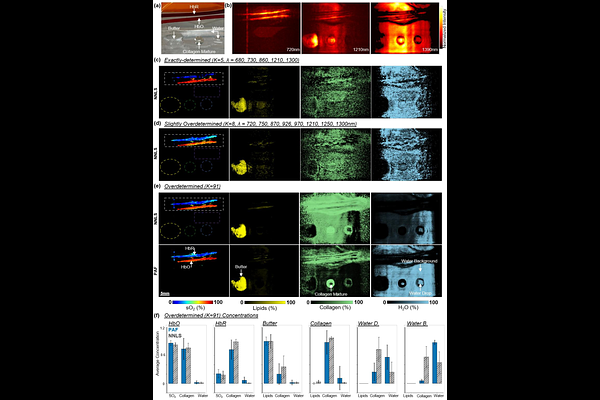
AbstractQuantitative molecular imaging in photoacoustics is fundamentally limited by the ill-posed nature of spectral unmixing, where spectral overlap, noise, and unknown fluence introduce bias in conventional inversion-based methods. We introduce photoacoustic fingerprinting (PAF), a framework that reframes spectral unmixing as a fingerprint recognition problem. PAF interprets multispectral signals as high-dimensional fingerprints encoding both molecular composition and measurement distortions. Inspired by magnetic resonance fingerprinting, PAF uses a recurrent neural network trained on synthetic data spanning realistic mixtures, noise levels, and fluence variations to directly infer molecular concentrations from spectral shape. PAF enables accurate and robust quantification in regimes where conventional methods break down, including low signal-to-noise conditions, spectrally correlated mixtures, and unknown fluence distortions. In controlled simulations, PAF consistently outperformed non-negative least squares, with the largest gains observed for spectrally overlapping chromophores such as collagen. In phantom studies, PAF improved molecular specificity by correctly localizing collagen and recovering water contrast despite similar spectral reconstructions. In ex vivo mouse livers, PAF detected lipid accumulation associated with steatosis, and in human arteries, it identified molecular signatures consistent with thrombus and lipid-rich plaque. These results establish PAF as a generalizable framework for label-free molecular imaging and a promising step toward quantitative photoacoustic diagnostics.