The modelling of community assembly during seagrass restoration

The modelling of community assembly during seagrass restoration
Allwright, J. C.; Bull, J. C.; Fowler, M. S.
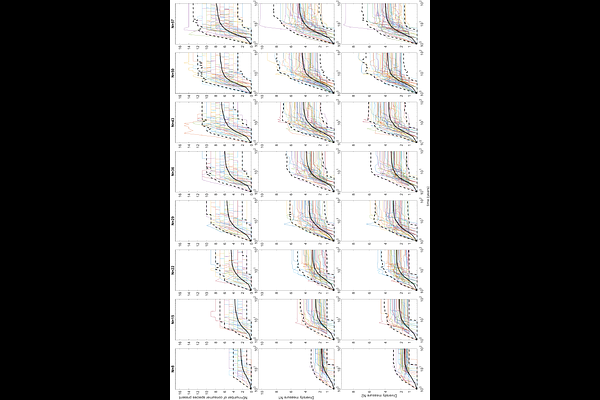
AbstractSuccessful seagrass restoration will provide habitat for a variety of species. Here, ecological community assembly in a newly planted seagrass meadow has been modelled mathematically using a combination of numerical integration and a permanence-based method, and using real data to parametrise the models. We have studied the transient dynamics of the system: how the ecological communities assemble and change over a 100-year period. Using a trophic structure and a range of species pool sizes, we investigated how much variability there was in community size for a given sized species pool, whether it is possible to use early monitoring to predict the final community size, and to what extent monitoring gives an indication of final vs transient species. For the majority of cases modelled, the community either reached or was headed towards an endpoint community which was uniquely determined by the species pool. However, for 1.4 % of cases, no unique endpoint community could be calculated. The simulated communities began to assemble within the first ten years, but 13 % had still not reached their endpoint community even after 100 years. In 62 % of our models, no consumer species colonised in the first two years, suggesting that monitoring should certainly be continued beyond a two-year period. We counted how many of the species that were present at any observation point in the 100 years would also be present in the endpoint community, and found that this proportion generally decreased with increasing species pool size, to an average of 86 % when the species pool had 49-56 consumer species. By monitoring the community over the first ten years, it is not possible to deduce what the final community will be; however a very small number of fauna species present over the first ten years might be used to predict very small endpoint communities.