Distinct Spatial Programs of Response versus Resistance in Non-Small Cell Lung Cancer after Neoadjuvant Chemoimmunotherapy

Distinct Spatial Programs of Response versus Resistance in Non-Small Cell Lung Cancer after Neoadjuvant Chemoimmunotherapy
Park, S. H.; Koh, J.; Bae, S.; Choi, H.; Yun, T.; Park, J. H.; Na, B.; Park, S.; Lee, H. J.; Park, I. K.; Kang, C. H.; Kim, Y. T.; Na, K. J.
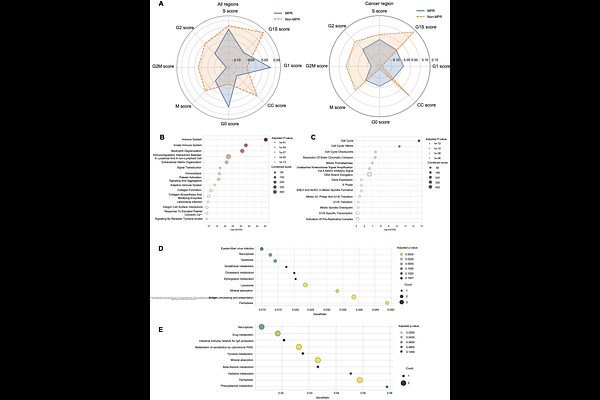
AbstractBackground: Neoadjuvant chemoimmunotherapy (nCIT) has become a standard treatment for locally advanced resectable non-small cell lung cancer (NSCLC), yet the spatial biology underlying treatment resistance remains poorly understood. We used spatial transcriptomics to define the microenvironmental architecture of residual cancers in patients who did not achieve major pathologic response (non-MPR) compared with those who did (MPR). Methods: Spatial transcriptomics was performed on 10 formalin-fixed paraffin-embedded tumor blocks (5 MPR, 5 non-MPR) obtained from 8 patients treated with nCIT. A deep learning algorithm was applied to detect viable residual cancer spots from treatment-induced fibrosis and necrosis. Spatial deconvolution, distance modeling, ligand-receptor analysis, and functional pathway scoring were integrated to characterize niche-specific programs. Results: MPR cancer core displayed an immune-permissive remodeling environment with deep infiltration of cytotoxic CD8+ T cells, mature dendritic cells (LAMP3+, CCR7+), and active efferocytosis signaling (APOE-TREM2), alongside robust MHC class II expression. Non-MPR cancer core, by contrast, exhibited spatial immune exclusion: a dense fibroblast barrier reinforced by TIMP1-CD63 signaling and Treg-enriched boundaries physically restricted effector T cell access to the cancer core. Residual cancer cells in non-MPR samples maintained active cell cycling and independently upregulated cytochrome P450-mediated drug detoxification and DNA damage response pathways without inducing MHC class II expression - effectively decoupling intrinsic survival from immune recognition. The non-MPR core also showed a hyper-metabolic profile, including elevated glutathione metabolism consistent with antioxidant buffering against chemotherapy-induced oxidative stress. TROP2 was broadly expressed across the non-MPR cancer core and colocalized with DNA damage response and nuclear factor erythroid 2-related factor 2 resistance signatures. Conclusions: Residual cancer cores in non-MPR tumors appear to represent evolved resistant niches sustained by structural immune exclusion, metabolic rewiring, and DNA repair proficiency. These findings highlight the spatial co-localization of epithelial anchors, such as TROP2, with intrinsic resistance pathways, providing a structural rationale for developing novel precision therapeutic strategies to bypass stromal barriers and overcome the cancer core's intrinsic repair capacity.