Chemodiversity is an independent synecological dimension of plant form and function

Chemodiversity is an independent synecological dimension of plant form and function
Hanusch, M.; Zizka, A.; Junker, R. R.
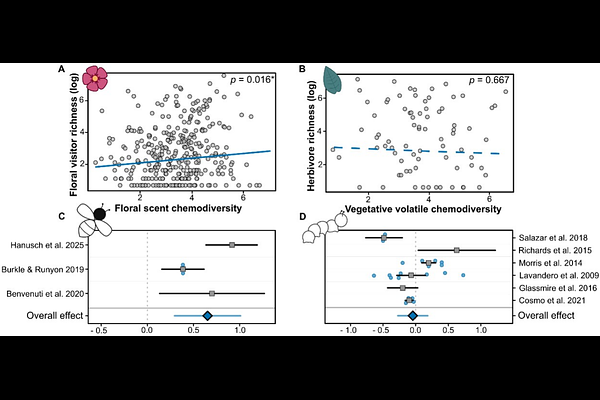
AbstractPlant trait spaces have advanced ecology by reducing the vast diversity of plant form and function to a few axes of trait variation. Yet, such frameworks remain dominated by autoecological traits related to resource acquisition and growth, while largely overlooking the traits mediating interactions with other organisms. Chemodiversity, the richness, evenness and chemical disparity of volatile organic compounds (VOCs) emitted by leaves and flowers to attract, deter, or otherwise affect biotic interaction partners, may represent such an overlooked synecological dimension of plant functional variation. By integrating the chemodiversity of floral (n = 859 species) and vegetative (n = 159 species) VOC profiles into the global spectrum of plant form and function, we show that chemodiversity is a) independent from the classical axis of variation in plant size and leaf economics but b) is linked to biotic interactions in organ-specific ways. Flower-visitor richness increases with floral scent chemodiversity, a pattern supported by an analysis of global interaction data and a meta-analysis of the specialization and generalization of flower-animal interactions. Vegetative VOC chemodiversity has context-dependent positive and negative effects on herbivore richness. VOC chemodiversity represents a distinct ecological strategy that defines interaction niches, thereby contributing to ecological differentiation and coexistence among otherwise functionally similar species.