Weak form Scientific Machine Learning for Systems Biology: A Tutorial on WENDy

Weak form Scientific Machine Learning for Systems Biology: A Tutorial on WENDy
Heitzman-Breen, N.; Lyons, R.; Jain, P.; Jolly, M. K.; Bortz, D. M.
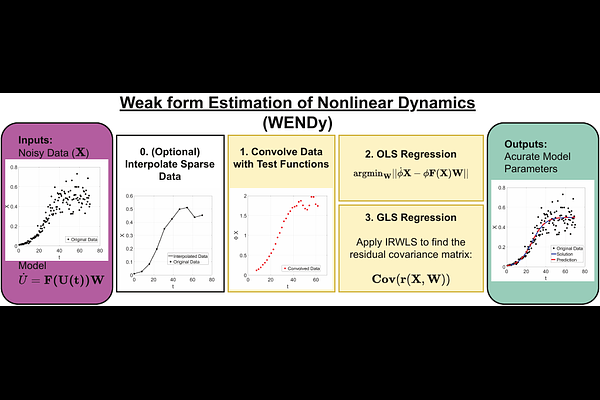
AbstractMechanistic ordinary differential equation models are widely used in systems biology to represent biochemical networks, population dynamics, cell-state transitions, and other biological processes; however, their predictive value depends critically on accurate parameter estimation from noisy and often sparse experimental data. In this tutorial, we present the Weak-form Estimation of Nonlinear Dynamics (WENDy) method as a forward-solver-free approach that reformulates parameter estimation as a covariance-corrected weak-form regression problem by integrating the model equations against compactly supported test functions. We present the background on the methodology through the lens of the familiar logistic equation, and we demonstrate applications of the method on real experimental data through two systems biology examples: a glycolytic oscillator with relatively dense time-course data and a sparse epithelial-mesenchymal cellstate transition model with multiple experimental replicates. Ultimately, using WENDy, we estimate interpretable biological parameters with uncertainty for systems with noisy and sometimes sparse available experimental data.