IL-32 is a stress-responsive node locked in a noncanonical NF-κB inflammatory loop during MASLD to HCC transition

IL-32 is a stress-responsive node locked in a noncanonical NF-κB inflammatory loop during MASLD to HCC transition
Zhao, L. N.; Kaldis, P.; Andersen, J.
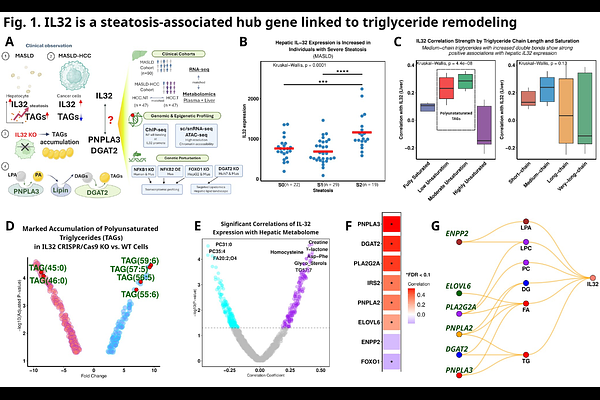
AbstractBackground: Interleukin-32 (IL-32) presents a long-standing paradox in liver disease, with markedly elevated expression in hepatocellular carcinoma (HCC) yet a protective role against hepatic steatosis. The absence of a canonical receptor or defined secretory pathway has obscured its biological function. This study aimed to resolve this paradox by delineating the regulatory mechanisms that govern IL-32 activity during hepatocarcinogenesis. Methods: We analyzed two in-house prospective cohorts, including a MASLD cohort and a MASLD-associated HCC cohort, integrating matched transcriptomic and metabolomic data. Targeted lipidomics and multi-omics analyses were combined with single-cell and spatial transcriptomics. Key findings were validated using functional assays and gene perturbation models. Results: We identified a disease stage-specific transcriptional switch in which noncanonical NF-{kappa}B signaling (NFKB2/RELB) replaces canonical NF-{kappa}B as the primary activator of IL-32, forming an auto-amplifying inflammatory loop. This switch is enabled by FOXO1, which acts as a pioneer factor to maintain chromatin accessibility at IL32 and NF-{kappa}B loci. Functionally, IL-32 is coupled to lipid metabolism through DGAT2; however, this axis becomes uncoupled in HCC, where DGAT2 loss rewires NF-{kappa}B/ERK signaling without recapitulating global metabolic remodeling, thereby sensitizing cells to inflammatory activation. Conclusions: These findings resolve the functional paradox of IL-32 by revealing a multi-layered regulatory network that reprograms its activity during liver disease progression, and define IL-32 as a context-dependent integrator of metabolic and inflammatory signaling, whose regulatory network is rewired during hepatocarcinogenesis to promote a sustained pro-inflammatory state.