Lipid moieties of sonic hedgehog are important for interaction with its inhibitor, WIF1

Lipid moieties of sonic hedgehog are important for interaction with its inhibitor, WIF1
Kerekes, K.; Trexler, M.; Banyai, L.; Patthy, L.
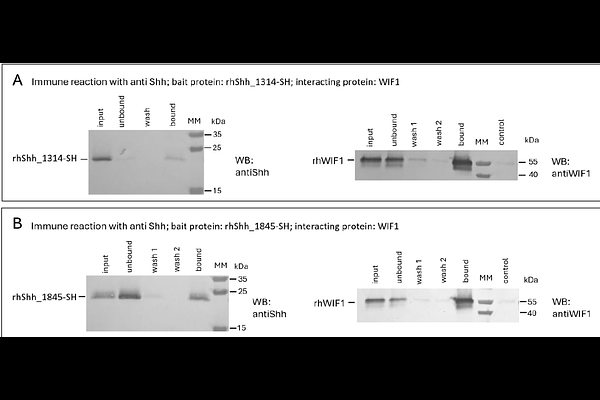
AbstractIt has been recognized a long time ago that the hedgehog (Hh) and Wnt signaling pathways have numerous similarities that suggest their common evolutionary origin. Although the Hh and Wnt proteins are unrelated they are similar in as much as they carry lipid modifications that are critical for their interaction with their receptors. In our earlier work we have shown that Wnt inhibitory factor 1 (WIF1), originally identified as a Wnt antagonist also binds to and inhibits the signaling activity of sonic hedgehog (Shh), raising the possibility that the lipid moieties of these unrelated morphogens play a dominant role in their interaction with WIF1. In the present work we have compared the interactions of human WIF1 protein with lipidated and non-lipidated forms of human sonic hedgehog (Shh) using Surface Plasmon Resonance spectroscopy and reporter assays monitoring the signaling activity of human Shh. Our studies have shown that human WIF1 protein has significantly higher affinity for lipidated than non-lipidated Shh, indicating that lipid modifications of Hhs are important for interactions with WIF1.