Topical Activatable Fluorescence Probes for Rapid Intraoperative Detection of Peritoneal Dissemination in High-Grade Serous Ovarian Carcinoma

Topical Activatable Fluorescence Probes for Rapid Intraoperative Detection of Peritoneal Dissemination in High-Grade Serous Ovarian Carcinoma
Sekine, H.; Fujita, K.; Yoshida, E.; Ueno, T.; Komatsu, T.; Hayashi, T.; Ogishima, D.; Sugimura, Y.; Urano, Y.; Terao, Y.
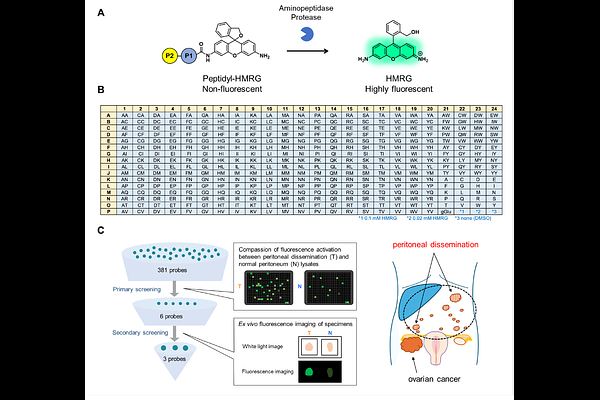
AbstractBackground: Epithelial ovarian cancer (EOC) is one of the most lethal gynecologic malignancies, largely because most patients are diagnosed at an advanced stage with peritoneal dissemination. High-grade serous carcinoma (HGSC), the most common and aggressive EOC subtype, requires complete cytoreductive surgery to improve the prognosis; however, minute disseminated lesions are often missed by conventional intraoperative inspection. Here, we aimed to develop fluorescence probes for rapid and sensitive intraoperative detection of HGSC peritoneal dissemination. Methods: We screened a hydroxymethyl rhodamine green (HMRG)-based fluorescence probe library consisting of 381 protease- and aminopeptidase-reactive fluorescence probes using tumor and non-tumor specimens from patients with HGSC. The target enzyme of the hit probes was identified by means of enzyme assays, immunohistochemistry, and LC/MS analysis. Diagnostic utility was evaluated ex vivo using clinical specimens and in vivo using a peritoneal dissemination mouse model. Results: Three probes--EK-HMRG, NA-HMRG and DA-HMRG--were selected as promising candidates for the detection of peritoneal dissemination in HGSC. Puromycin-sensitive aminopeptidase (PSA) was identified as a novel target enzyme of these probes. EK-HMRG, NA-HMRG and DA-HMRG rapidly detected peritoneal dissemination just a few millimeters in size with high sensitivity and specificity in clinical HGSC specimens and in a peritoneal dissemination mouse model after topical application. Conclusions: The PSA-targeting topical fluorescence probes EK-HMRG, NA-HMRG and DA-HMRG are promising tools for real-time, highly sensitive intraoperative visualization of peritoneal dissemination in HGSC, and are promising candidates to improve complete resection rates.