Genetic Variability and Population Structure within the Anopheles tessellatus complex (Theobald, 1901) in Indonesia using ITS2 nuclear and COI, COII mitochondrial sequences

Genetic Variability and Population Structure within the Anopheles tessellatus complex (Theobald, 1901) in Indonesia using ITS2 nuclear and COI, COII mitochondrial sequences
Nurwidayati, A.; Purwanto, H.; Astuti, R. R. U. N. W.; Nugraheni, Y. R.; Susanti, L.; Srikandi, Y.; Daryono, B. S. W.; Garjito, T. A.; Manguin, S.
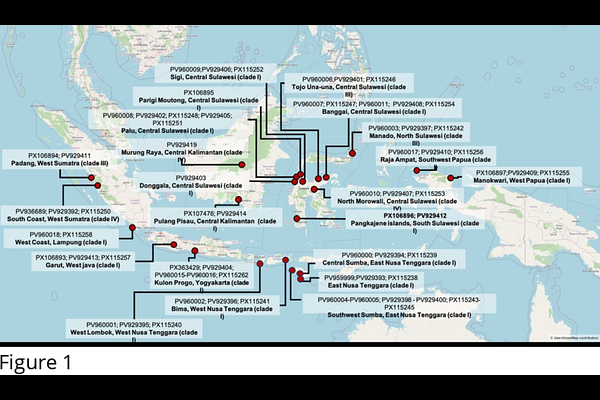
AbstractSome Anopheles species that act as malaria vectors are members of species complexes, a concept whereby sibling species cannot be differentiated solely on the basis of morphological characters. Therefore, species complexes represent a major problem in malaria vector control, because within an Anopheles complex, vectors cannot be differentiated from non-vector species, unless molecular techniques are used to identify them. The Anopheles tessellatus species complex is an important potential vector in South, East, and Southeast Asia, including certain regions of Indonesia. However, no in-depth studies have been conducted on this species complex in that country. Therefore, this study investigated the taxonomic status of An. tessellatus from diverse populations across five Indonesian islands (Sumatra, Java, West Nusa Tenggara, East Nusa Tenggara, and Sulawesi) and identified interpopulation genetic variation based on molecular data of the ITS2, COI, and COII genes. Phylogenetic relationships were constructed using the Maximum Likelihood method. Haplotype and network analysis were also conducted. The results indicate that An. tessellatus constitutes a monophyletic group comprising three well?defined lineages that exhibit clear intraspecific genetic differentiation. Cluster 1 corresponds to the population of Sumatra, Cluster 2 represents population from Sulawesi, and Cluster 3 encompasses populations from Java, West Nusa Tenggara, and East Nusa Tenggara. These findings demonstrate high haplotype diversity and low nucleotide diversity within the species. Populations from West Sumatra, Manado, Tojo Una - Una, and North Morowali (Sulawesi) have the potential for speciation with a genetic distance of 0.61 - 0.94% for COI, between 0.81 - 0.95% for ITS2, and between 0.62 - 0.71% for COII. These findings underscore the need for further integrative studies to obtain a more comprehensive understanding of the An. tessellatus complex in Indonesia and its role in malaria transmission.