Molecular basis of TSC complex GAP activity

Molecular basis of TSC complex GAP activity
Titze, S.; Ruettermann, M.; Nellist, M.; Kuemmel, D.
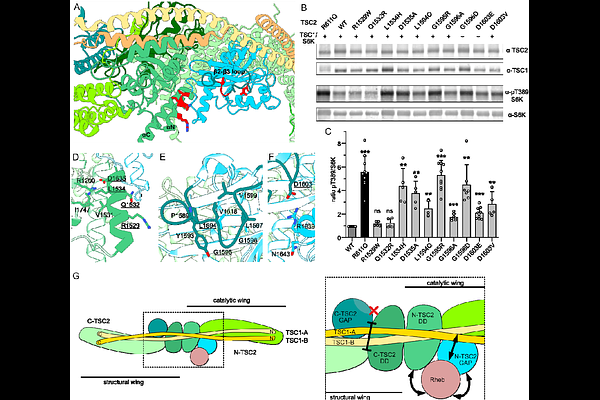
AbstractThe tuberous sclerosis complex (TSC) protein complex (TSCC) acts as the GTPase activating protein (GAP) for the small GTPase Rheb, to limit mTORC1 (mechanistic target of rapamycin complex 1) activity and cellular growth. We report the structure of the catalytic transition state complex of TSCC and Rheb. Assembly of two TSC2 subunits containing asparagine-thumb GAP domains with two accessory TSC1 subunits is required for function in cells. Catalysis requires the asparagine-thumb residue of TSC2 and conserved residues in Rheb that bind TSC2 at multiple interaction sites. Surprisingly, only one TSC2 GAP domain is catalytically competent and interacts with Rheb. This is realized by asymmetric binding of TSC1, which enables activating structural changes in one of the TSC2 subunits and locks the second TSC2 copy in an inactive conformation. We identify TSC2 variants that affect conformational coupling within TSCC and binding to Rheb. The structure thus explains the catalytic mechanism of TSCC and reveals an allosteric role of TSC1 in this process.