Structural basis for the unexpected activity of rifamycin B against rifampicin-resistant RNA polymerase

Structural basis for the unexpected activity of rifamycin B against rifampicin-resistant RNA polymerase
Mosaei, H.; Shin, Y.; Kozhevnikov, V. N.; Waddell, P. G.; Hall, M. J.; Murakami, K. S.; Zenkin, N.
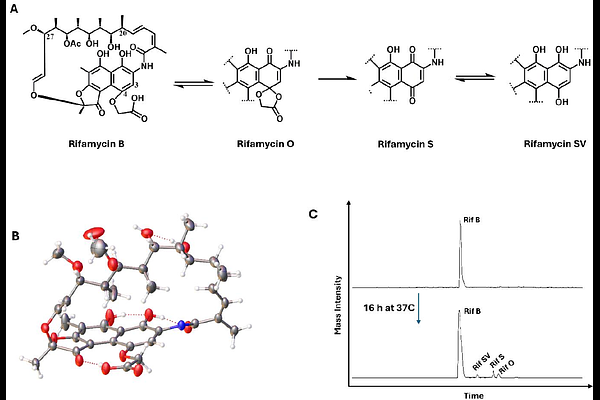
AbstractRifamycins inhibit bacterial transcription by targeting RNA polymerase (RNAP), but their clinical effectiveness is limited by the rapid emergence of resistance caused by mutations within the rifamycin-binding pocket. Rifamycin B (Rif B), one of the earliest discovered members of this antibiotic family and a precursor of clinically used derivatives, has remained poorly characterized because of its chemical instability and relatively weak antibacterial activity. Here, we revisit Rif B using biochemical and structural approaches. We show that Rif B remains sufficiently stable under assay conditions and retains inhibitory activity against RNAP variants carrying clinically relevant rifampicin-resistance mutations. We report the first crystal structure of Rif B and determine the structure of Rif B bound to bacterial RNAP. The structures reveal that the distinctive C-4 O-carboxymethyl substituent of Rif B forms an intramolecular interaction in the free molecule but establishes a salt bridge with fork loop 2 of the RNAP {beta}-subunit upon binding. This additional interaction explains the reduced sensitivity of Rif B to resistance-associated substitutions and identifies the C-4 position as an underexplored site for rational rifamycin modification. These findings redefine Rif B as a mechanistically distinct rifamycin scaffold and provide new insights for developing inhibitors targeting rifampicin-resistant RNAP.