One Health genomic surveillance reveals structured urban rabies transmission and major surveillance gaps

One Health genomic surveillance reveals structured urban rabies transmission and major surveillance gaps
Brunker, K.; Davila-Barclay, A.; Diaz, E. W.; Kasaragod, S.; Durrant, R.; Hampson, K.; Zegarra, E.; Monroy, Y.; Castillo-Neyra, R. C.-N.
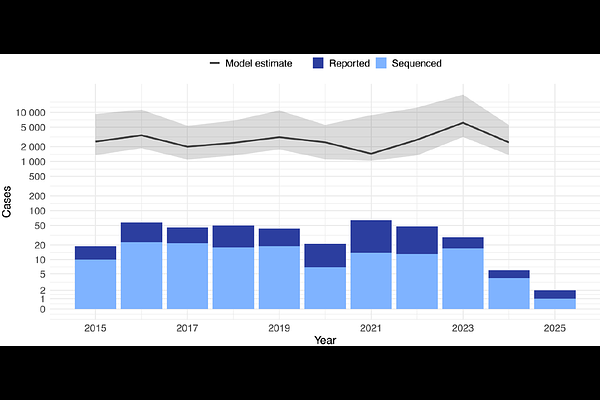
AbstractPersistent local foci remain a barrier to eliminating dog-mediated rabies. The processes sustaining micro-scale transmission, particularly in complex urban systems, remain poorly understood. We apply an integrated One Health genomic epidemiology framework to reconstruct a decade-long rabies virus (RABV) epidemic in Arequipa, Peru. Combining 133 new whole genomes with existing data, we produce the most comprehensive canine RABV dataset in Latin America and use whole-genome-informed phylogenetic, phylodynamic, and landscape analyses, to trace the epidemic from its first detection in 2015. Transmission was dominated by a single lineage estimated to be introduced around 2012, which spread for approximately 3 years before detection. We find that only 1-2% of infections are routinely detected, revealing extensive cryptic transmission and undermining case-based metrics for verifying disease freedom. Additional regional and transboundary introductions were detected, but only one resulted in sustained transmission. Within Arequipa city, transmission is highly structured, concentrated in densely populated and socioeconomically deprived areas, and shaped by urban connectivity, with roads and dry water channels facilitating spread and rivers acting as partial barriers. Together, our findings demonstrate that rabies persistence reflects interacting processes across spatial scales and support genomic-informed, spatially targeted surveillance and control strategies.