Declines in mRNA synthesis set the rate of organismal aging

Declines in mRNA synthesis set the rate of organismal aging
Del Carmen-Fabregat, A.; Oswal, N.; Sinha, K.; Vicencio, J.; Abramowitz, R.; Eder, M.; Begik, O.; Sedlackova, L.; Novoa, E. M.; Stroustrup, N.
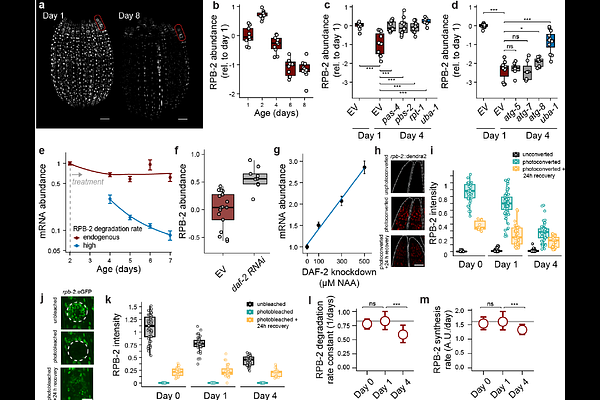
AbstractThe abundance of mRNA sets a ceiling on a cells capacity to produce protein and carry out its functions. Here, we describe a pathological decline in absolute mRNA abundance that occurs in most cell types during invertebrate and mammalian aging, caused by decreases in mRNA synthesis capacity. In C. elegans, decreases in mRNA abundance are tightly coupled to declines in RNA Polymerase II (Pol II) protein abundance. Measuring Pol II abundance dynamics in vivo, we find that individuals enter adulthood with a four-fold excess of Pol II, whose kinetic equilibration towards its homeostatic set point drives reductions in mRNA abundance and, in turn, organismal aging. Briefly accelerating Pol II declines produces permanent, dose-dependent reductions in healthspan and lifespan, whereas deceleration extends both. Although disrupted cellular homeostasis is conventionally seen as a consequence of aging, our results reveal how an out-of-equilibrium state established during development provides a driving force for aging.