Local trait responses and aquatic microclimates increase projected habitat suitability for field-collected Anopheles stephensi in southern Ethiopia

Local trait responses and aquatic microclimates increase projected habitat suitability for field-collected Anopheles stephensi in southern Ethiopia
Huxley, P. J.; Machani, M. G.; Hawaria, D.; Rund, S. S. C.; Yan, G.
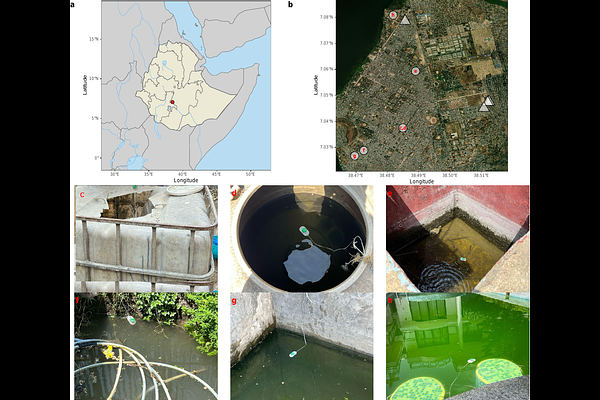
AbstractBackground Trait-based models of mosquito environmental suitability commonly use global thermal performance curves compiled from laboratory studies. These curves may misrepresent suitability when local populations or larval habitats differ from globally synthesised expectations. This issue is particularly relevant for Anopheles stephensi, an urban malaria vector expanding in the Horn of Africa, where artificial aquatic habitats may generate microclimates poorly represented by global trait datasets or gridded air-temperature products. Methodology/Principal Findings We compared juvenile survival, development, and projected maximal population growth rate, rm, using locally measured data from field-collected Ethiopian An. stephensi and a global comparator combining published juvenile trait data. We fitted thermal performance curves for juvenile survival and development, used these curves to estimate temperature-dependent rm as a metric of habitat suitability, and projected rm across two matched temperature inputs: logger-measured larval habitat water temperature and ERA5-Land 2 m air temperature. Local juvenile trait responses produced higher projected rm than the global comparator across monitored habitats. Measured aquatic temperatures were warmer than ERA5-Land air temperatures, with a mean daily water-air offset of 3.26{degrees}C, and were more spatially heterogeneous among habitats. ERA5-Land resolved only two unique temperature series across the six monitored habitats. Sensitivity analyses showed that the Local-Global difference was robust for logger-measured water temperatures, whereas the ERA5-based difference was partly amplified by cooler temperatures below the local experimental range. Conclusions/Significance This study provides the first locally derived juvenile thermal performance curves and temperature-dependent population growth estimates for field-collected An. stephensi in Africa, demonstrating that locally measured juvenile traits consistently predict higher habitat suitability than globally synthesised trait data. These findings highlight the importance of incorporating local mosquito trait data and aquatic microclimate measurements into predictive models to improve assessments of An. stephensi establishment, spread, and malaria risk in newly invaded urban environments.