A Comparison of Mechanisms Driving Lesion Outcomes during Lung Tumor and Tuberculosis Granuloma Formation

A Comparison of Mechanisms Driving Lesion Outcomes during Lung Tumor and Tuberculosis Granuloma Formation
Michael, C. T.; Budak, M.; Kirschner, D.
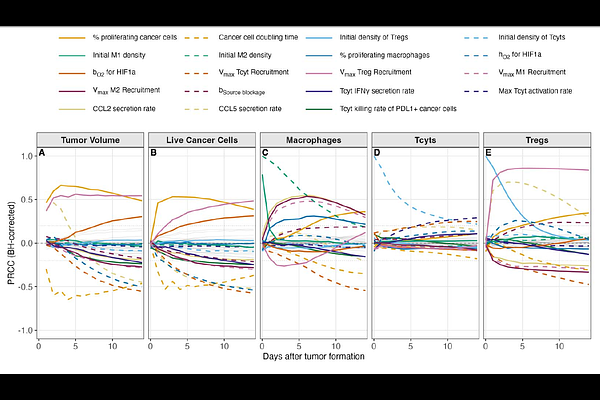
AbstractSmall cell lung cancer (SCLC) and tuberculosis (TB) are both deadly diseases that present with spatially complex lung lesions. These lesions share many similarities, including several key spatial interactions between T cells and macrophages. Both SCLC and TB present with significant heterogeneity, both in terms of progression of disease and responses to treatment; current experimental methods have few tools to investigate the spatiotemporal evolution of these lesions within human lungs. We have applied our computational agent-based model, GranSim, to extensively study heterogeneity of TB granuloma scale formation, infection outcome and treatment in detail. We introduce TumorSim, an analogous agent-based model designed to understand the heterogeneity of SCLC lung tumors. TumorSim mechanistically and spatio-temporally captures immune-tumor interactions, many of which are well-studied in isolation, including cytokine-based recruitment of adaptive cells and PD1/PDL1-based inhibition of cytotoxic T-cell activity. Drawing from known lung immunology as well as literature on lung tumor responses, we define and explore a wide set of parameters to characterize TumorSim behavior using global sensitivity analysis. We compare factors that drive dynamics of both SCLC tumors and TB granulomas. As model validation, sensitivity analysis captures several well-known correlates of improved SCLC outcomes including macrophage-mediated cytotoxic T-cell recruitment. Surprisingly, both models predict a two-phase formation process occurring with an abrupt change in tumor/granuloma dynamics upon arrival of adaptive immune cells into the lung from lung-draining lymph nodes. Simulations suggest that while CCL5 is associated with improved tumor control later during tumor growth, CCL5 plays a pro-tumor role early during tumor growth by recruiting regulatory T cells. We also find that, similar to virtual TB granulomas, TumorSim tumors are increased in volume when immunosuppressive mechanisms outweigh pro-inflammatory responses. This novel tumor model can serve as a basis for future studies on lung tumor-immune dynamics to study both immunotherapeutics and anti-cancer drugs.