Transposable elements shape olaparib response according to BRCA1 status in triple-negative breast cancer

Transposable elements shape olaparib response according to BRCA1 status in triple-negative breast cancer
Moreira Mombach, D.; Mendez-Dorantes, C.; Mercuri, R. L. V.; Schofield, P.; Soares Baal, S. C.; Poersch, M. A.; Burns, K. H.; Carvalho de Oliveira, J.; Loreto, E. L. S.; Galante, P. A. F.
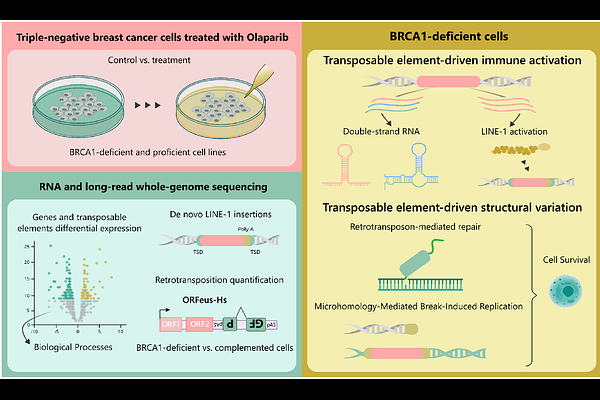
AbstractBackground: Triple-negative breast cancer (TNBC) is an aggressive subtype with limited therapeutic options. While PARP inhibitors, such as olaparib, show promise in BRCA1-deficient TNBC through synthetic lethality, up to 50% of patients fail to respond, highlighting the need to understand the molecular mechanisms underlying PARP inhibitors efficacy. Transposable elements (TEs), particularly LINE-1 elements, are increasingly recognized as modulators of genomic instability associated with DNA repair processes and potential key players in synthetic lethality. Here, we investigate the functional relationship between TE activity and olaparib treatment in TNBC with distinct BRCA1 functional status. Methods: We performed comprehensive multi-OMICs analysis of four TNBC cell lines (two BRCA1-deficient: SUM1315 and MDA-MB-436; two BRCA1-proficient: MDA-MB-468 and BT549) treated with olaparib. We analyzed expression and differential expression of protein-coding genes, TEs, and gene-TE chimeric transcripts. Long-read whole-genome sequencing was employed to detect de novo TE insertions, complemented by a functional assay to quantify LINE-1 retrotransposition activity in olaparib-treated cells. Results: Olaparib treatment induces extensive transcriptomic and genomic disorganization mediated by TEs, especially LINE-1, exclusively in BRCA1-deficient cells. We observed aberrant overexpression of both genes and TEs, including gene-TE chimeric transcripts harboring poison exons within tumorigenic genes and multi-exonic TE-TE chimeras capable of forming immunostimulatory double-stranded RNA (dsRNA) structures. Functional enrichment analyses revealed activation of antiviral immune pathways linked to LINE-1 activity. Consistently, orthogonal assays confirmed LINE-1 retrotransposition in BRCA1-deficient cells following olaparib exposure. Conclusions: Our findings demonstrate that olaparib treatment induces TE activation especially in BRCA1-deficient cells, a novel mechanism that may underlie synthetic lethality in TNBC. This TE activation triggers immune responses and genomic instability, providing new therapeutic opportunities through immunotherapy combinations and suggesting that TE activity may serve as a potential biomarker for treatment stratification of TNBC.