Collateral effects of lethal management operations: biologging reveals multiscale responses in non-target vervet monkeys

Collateral effects of lethal management operations: biologging reveals multiscale responses in non-target vervet monkeys
Brun, L.; Tankink, J. A.; Van de Waal, E.
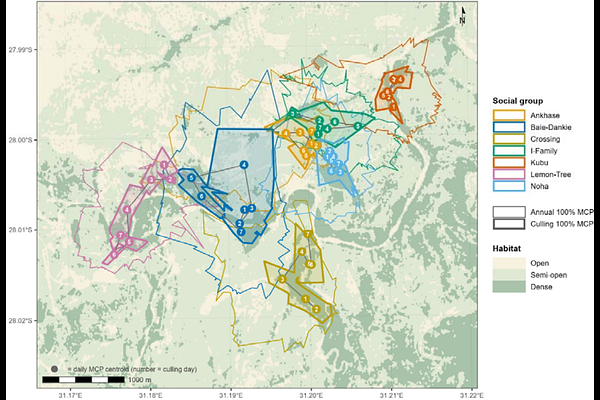
AbstractLethal wildlife management operations are typically evaluated through their direct effects on target species, yet their disturbance footprint may extend to non-target animals sharing the same landscape. We opportunistically used a large-scale helicopter-assisted culling event targeting ungulates at Mawana Game Reserve, South Africa, as a natural experiment to examine how such an operation affected the behaviour and space use of non-target vervet monkeys (Chlorocebus pygerythrus). Using GPS and tri-axial accelerometry from 21 collared individuals across seven habituated social groups, we quantified behavioural and spatial responses around the culling event, including changes in activity budgets, circadian activity patterns, short-term walking and running responses, daily space use, and habitat composition. Vervets showed fear-consistent responses that differed among behaviours, social groups, and temporal scales. Foraging declined at the population level, with the strongest reduction occurring in the morning, when helicopter and shooting activity were the most intense. Inactivity increased during culling and remained elevated afterwards, suggesting both disturbance-related change and seasonal background effects, while social behaviour showed a transient increase consistent with a possible social-buffering response. Walking and running showed little consistent change in daily averages across the culling period, but finer-scale analyses revealed short-lived deviations concentrated in specific groups and time windows. Spatially, groups remained within existing ranges but showed divergent responses, from contraction and increased use of dense vegetation to greater movement in more open areas, highlighting how population-level inference can obscure context-dependent responses when heterogeneity among groups, individuals, or habitats is not explicitly considered. Together, our findings show that lethal management can generate multi-scale, context-dependent responses in non-target wildlife, and that overlooking these effects may lead to systematic underestimation of their ecological consequences.