Local negative frequency-dependence can decrease global coexistence in fragmented populations

Local negative frequency-dependence can decrease global coexistence in fragmented populations
Devadhasan, A.; Carja, O.
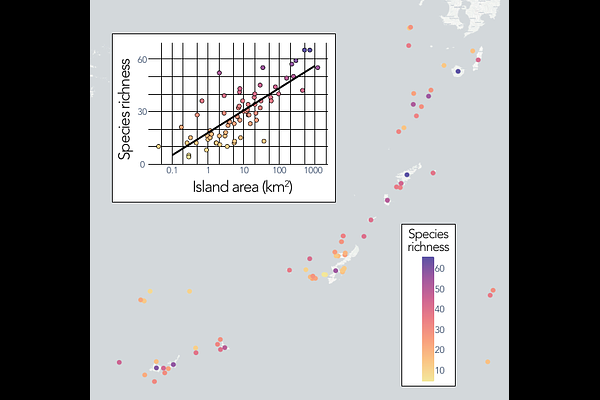
AbstractMost biological populations are rich in diversity, and negative frequency-dependent (NFD) selection is a well-established mechanism thought to underlie this stable coexistence of multiple variants. Recent studies confirm its widespread presence at local spatial scales, however it remains unclear whether these local-scale dynamics are sufficient to maintain biodiversity across larger, landscape-level scales. While prior theoretical work has found that local NFD selection can indeed promote global coexistence, these studies only analyzed contiguous landscapes. In contrast, many ecosystems are not contiguous, but rather spatially fragmented or exhibit spatial variation in the local carrying capacity. Using a theoretical model based on the classic island framework, we show that in fragmented populations, NFD selection can paradoxically reduce coexistence and shorten fixation times, relative to neutrality. Fragmentation also produces a non-monotonic relationship between fixation time and population size, with diversity lowest at intermediate scales, in contrast to the classical species-area relationship. We show that these results persist in a multispecies modeling framework. We also develop a statistical test to detect whether NFD selection suppresses coexistence in fragmented systems, and apply it to a presence-absence dataset of avian species in the Ryukyu Islands, finding evidence that NFD selection indeed reduces biodiversity in this case. Together, our findings suggest that fragmentation can undermine the stabilizing effects of NFD selection, calling into question its generality as a mechanism for maintaining biodiversity in heterogeneous landscapes.