The discovery of an external bacterial niche reconciles sequencing-based microbiomes in a freshwater sponge

The discovery of an external bacterial niche reconciles sequencing-based microbiomes in a freshwater sponge
Pawley, J. S.; Nichols, S. A.
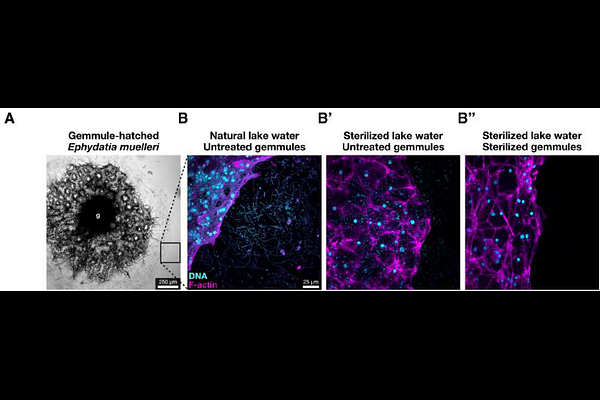
AbstractAnimals maintain beneficial associations with microbes while avoiding parasitism, often by physically segregating microbes from host tissues. Sponges are frequently cited as an exception to this principle and are known to harbor symbiotic bacteria in an interior space composed of host extracellular matrix and migratory cells, termed the mesohyl. Yet, this view is based largely on studies of marine species, and evidence from freshwater sponges is conflicting: sequencing surveys often support stable resident microbiomes, whereas limited available imaging data indicate that few bacteria occupy the mesohyl. Here, we use confocal microscopy and fluorescence in situ hybridization (FISH) to determine where sponge-associated bacteria actually reside and how they are transmitted in the freshwater sponge Ephydatia muelleri. We find limited evidence for abundant communities of bacteria in the mesohyl, nor do our data support transmission of bacterial symbionts across periods of seasonal dormancy, within the interior of gemmules (stress-resistant propagules). Instead, we find that bacteria are largely confined to a secreted external matrix that underlies the basal epithelium, coats spicules, and envelops gemmules. This matrix supports dense microbial communities in both laboratory cultures and field-collected specimens, while a continuous epithelium acts as a barrier between this matrix and the mesohyl. These findings contextualize sequencing-based reports of freshwater sponge microbiomes with spatially resolved imaging, and highlight that spatial context--not sequence data alone--is essential for interpreting host-microbe associations.