Impacts of genome architecture on the repeatability of polygenic adaptation

Impacts of genome architecture on the repeatability of polygenic adaptation
Du, Z.; Wirtz, J.; Li, Q.; Taylor, A.; Larsen, L.; Lu, S.; Stern, D. B.; Lee, C. E.
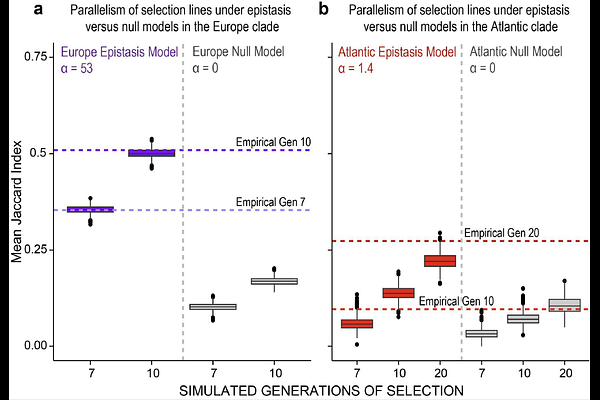
AbstractA central but poorly resolved question regards how genome architecture shapes the selection response and repeatability of polygenic adaptation. We addressed this question using Evolve-and-Resequence experiments under rapid salinity decline in two sibling species (clades) of the invasive copepod Eurytemora affinis complex that differ strikingly in chromosome number (15 versus 4). The 4-chromosome genome arose from chromosomal fusions of the ancestral 15-chromosome genome, bringing together coadapted alleles at fusion sites. Across 10-20 generations of selection, both clades adapted to low salinity but followed divergent evolutionary trajectories. The selection lines of the 15-chromosome clade exhibited highly parallel genomic responses, whereas the 4-chromosome clade lines showed delayed and less repeatable responses. Forward genetic simulations revealed that strong synergistic epistasis among beneficial alleles best explained elevated parallelism in the 15-chromosome clade. Additional simulations varying chromosome number and epistasis revealed that strong positive epistasis, combined with high chromosome numbers, enhances parallelism by enabling recombination to assemble coadapted allelic combinations. In contrast, the high starting frequency of beneficial alleles in the 4-chromosome clade lines indicated selection on standing variation, likely acting on alternative linked haplotypes. These findings demonstrate that genome architecture and gene-gene interactions jointly determine the dynamics and predictability of polygenic adaptation.