Covalent remodeling of CRBN creates a non-canonical neosubstrate interface with NTAQ1

Covalent remodeling of CRBN creates a non-canonical neosubstrate interface with NTAQ1
de la Pena, A. H.; Cruite, J. T.; Che, J.; Matyskiela, M. E.; Chamberlain, P. P.; Fischer, E. S.; Jones, L. H.
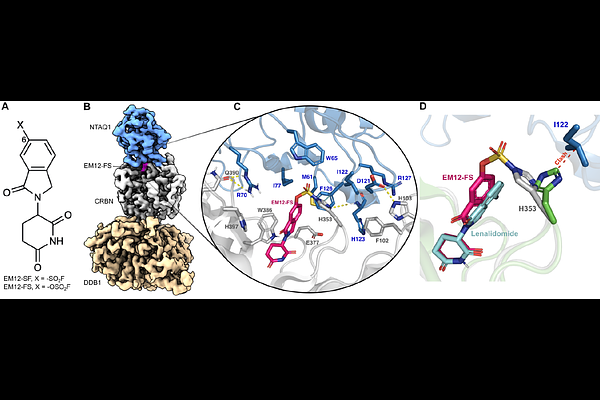
AbstractMolecular glue degrader EM12-FS covalently modifies cereblon (CRBN) His353, enabling selective recruitment of the neosubstrate NTAQ1 to the CRL4CRBN ubiquitin ligase. We determined the cryo-EM structure of the NTAQ1-EM12-FS-CRBN-DDB1 complex, revealing a non-canonical neosubstrate interface created by covalent remodeling of the CRBN sensor loop. Imidazylation repositions His353 to eliminate the steric clash that prevents NTAQ1 engagement by reversible IMiDs, and the engineered interface is stabilized by a distinctive T-shaped C-H/{pi} interaction between sulfated His353 and NTAQ1 Phe126. Biochemical and mutational analyses define the determinants of ternary complex formation and ubiquitination. These findings show that site-specific synthetic modification of CRBN can reprogram induced-proximity pharmacology, expanding specificity beyond the G-loop degron and establishing a framework for covalent engineering of new degrader modalities.