The Unlabeled Organ: Adipose tissue and normativity in anatomy and physiology texts

The Unlabeled Organ: Adipose tissue and normativity in anatomy and physiology texts
Hermsmeyer, I. D. K.; MacDougald, O. A.; Orczykowski, M. E.
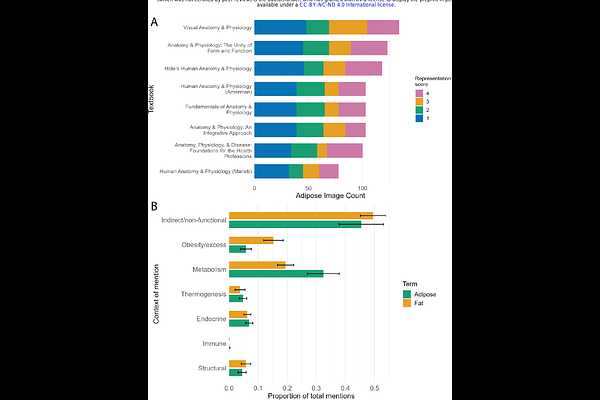
AbstractAdipose tissue is a dynamic and essential organ system with roles in metabolism, endocrine signaling, immune function, thermoregulation, and structural support. Despite this, it has historically been framed as inert or pathological, raising questions about how it is represented in biomedical education. We evaluated the visual and textual representation of adipose tissue across widely used anatomy, physiology, and combined anatomy-physiology textbooks. Images were coded for presence, labeling, and degree of representation, and text mentions of "adipose" and "fat" were quantified across functional contexts. In anatomy textbooks, adipose tissue was frequently present (6.6-21.7% of images) but rarely labeled (<5% of all images; <25% of adipose-containing images). Representation was often minimal or incidental, and text descriptions were predominantly non-functional, with a preference for the term "fat." In physiology textbooks, adipose tissue was more often described in functional terms and more frequently referred to as "adipose," particularly in metabolic contexts, but appeared in relatively few images (<5%) and was typically minimally depicted. Combined anatomy-physiology texts showed intermediate patterns but retained low labeling rates and limited integration of structure and function. Across all textbook types, terminology varied by context, with "fat" more common in non-functional and obesity-related descriptions and "adipose" associated with metabolic functions, suggesting context-dependent bias in terminology. Overall, adipose tissue is present but inconsistently framed across visual and textual domains. This fragmentation may limit recognition of adipose tissue as an integrated organ system and may reinforce reductive or stigmatizing interpretations. Aligning educational representations with current scientific understanding is therefore essential to support a more accurate and integrated view of adipose tissue as a dynamic organ system.