A conserved hydrophobic interaction governs GPCR-transducer association

A conserved hydrophobic interaction governs GPCR-transducer association
Hahn, H.; Flores-Espinoza, E.; Nguyen, A.; Jung, M.; Plouffe, B.; Thomsen, A.
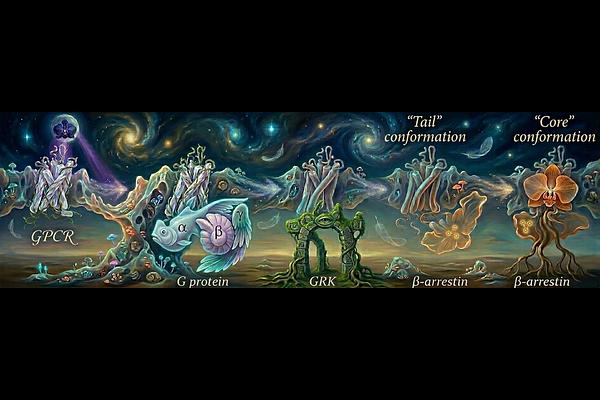
AbstractA central feature of G protein-coupled receptor (GPCR) desensitization is the direct competition between heterotrimeric G proteins and {beta}-arrestins ({beta}arrs) for an overlapping binding site within the intracellular receptor cavity. Although numerous high-resolution structures of GPCR-transducer complexes exist, the exact nature of this shared site and the molecular basis of transducer competition remain unclear. To investigate this, we employed an interdisciplinary approach integrating systemic mutational mapping, bioinformatics, and structural analysis across multiple classes of GPCRs and their transducers and regulators. We identified two highly conserved leucine residues within both the {beta}arr finger loop and the G C-terminal -helix, which engage a hydrophobic patch on GPCRs formed by TM3, TM5, and TM6 in a nearly identical manner, thereby stabilizing the complexes. Notably, the GPCR kinase N-terminal -helix also contains hydrophobic residues that associate with this same receptor patch and are vital for the GPCR-GRK engagement. Our findings reveal a conserved hydrophobic interface that mediates direct competition among GPCR transducers and regulators suggesting a universal mechanism that governs receptor access and desensitization.