Direct Binding of Cysteine-367 Thiolate to the Active Site of the -Hydrogenase from Clostridium beijerinckii in the O2-stable State

Direct Binding of Cysteine-367 Thiolate to the Active Site of the -Hydrogenase from Clostridium beijerinckii in the O2-stable State
Duan, J.; Arrigoni, F.; Rutz, A.; Hofmann, E.; Greco, C.; Happe, T.
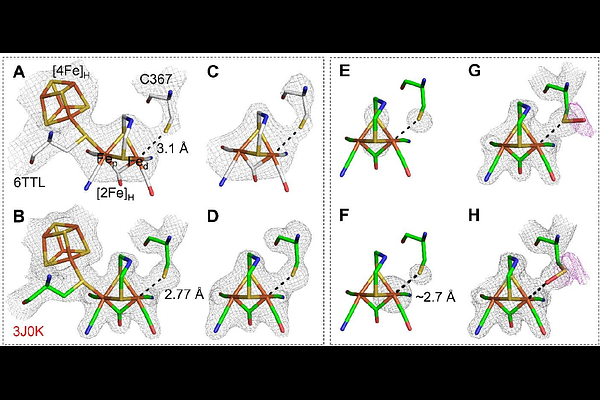
Abstract[FeFe]-hydrogenases are very active biocatalysts for H2 conversion. However, their active site is vulnerable to irreversible degradation initiated by O2 binding at the catalytic iron ion (Fed) of the active center. CbA5H, the [FeFe]-hydrogenases from Clostridium beijerinckii exhibits stability towards oxygen (O2) due to its ability to reversibly enter an inactive state termed Hinact upon contact with O2. We previously proposed that the close distance of approximately 3.1 [A] between the thiol of a nearby cysteine (C367) and the Fed, based on a 2.9 [A] crystal structure of CbA5H in the Hinact state, enables their binding to each other. This binding therefore was suggested to shield the Fed from O2 damage. However, there is currently a lack of evidence to support this hypothesis. Furthermore, density functional theory (DFT) calculations based on a homologous model favored hydroxide as the binding ligand of the Fed over the thiol of C367. In this study, we present the crystal structure of CbA5H in the Hinact state at an improved resolution of 2.15 [A]. The structure reveals a direct binding between the thiol of C367 and the Fed with a distance of approximated 2.77 [A] which is well supported by our DFT calculations based on the new crystallographic data. It is noteworthy that the 2.77 [A] bond distance is strikingly long when compared with other iron-sulfur bonds. This finding may provide a crucial foundation for understanding the rapid reversibility of the Hinact state.