The Nematicide Tioxazafen Disrupts Proteasome Function via Cytochrome P450 Bioactivation

The Nematicide Tioxazafen Disrupts Proteasome Function via Cytochrome P450 Bioactivation
Chen, L.; Thompson, K.; Kamal, M.; Sihuta, K.; Topalidou, I.; Burns, A. R.; Farshour, N. H.; Cooke, B.; Knox, J.; Jiang, Y.; Al Qasser, M.; Shuteriqi, E.; Usaj, M.; Ching, J.; Flaget, A.; Costanzo, M.; Tan, G.; Lacoste, J.; Lautens, M.; Andrews, B. J.; Boone, C.; Taipale, M.; Lehrbach, N. J.; Roy, P.
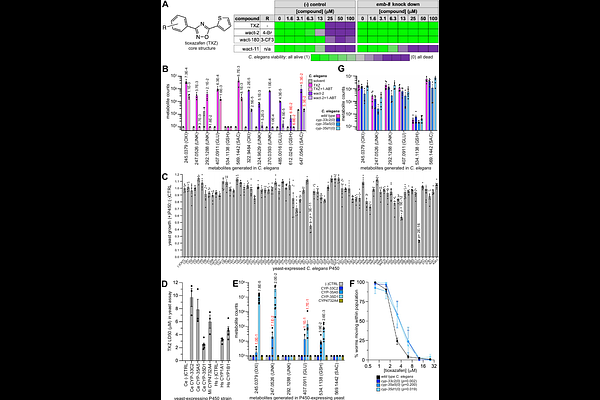
AbstractTioxazafen is an effective nematicide whose commercialization was halted because handlers reportedly developed rashes after working with seeds coated with a tioxazafen-laced cocktail. Here, we show that tioxazafen is bioactivated into toxic products by nematode and human cytochrome P450s. Through systematic analyses, we found that bioactivated tioxazafen disrupts proteasome function, leading to the accumulation of the NRF1 transcription factor ortholog SKN-1A in the nematode C. elegans, and a bounce-back transcriptional up-regulation of proteasome components. Genetic upregulation of the C. elegans proteasome supresses the lethality induced by tioxazafen, indicating that proteotoxicity is a key contributor to death. A survey of human P450s revealed that skin-expressed CYP1A1 toxifies tioxazafen and may account for the reaction to tioxazafen-coated seeds. We also found that rabbit CYP1A1 fails to bioactivate tioxazafen, which may explain the pre-market failure to detect robust adverse skin reactions. Our work highlights vulnerabilities in pre-market toxicological assays and a provides potential solution to prospectively identifying P450 toxication events.