Nutritional Anthelmintics: Chicory Reconfigures the Equine Holobiont Across Microbial, Parasitic, and Host Scales

Nutritional Anthelmintics: Chicory Reconfigures the Equine Holobiont Across Microbial, Parasitic, and Host Scales
Mach, N.; Mendez, S.; Malsa, J.; Auclair, J.; Bars, D.; Sevillia, M.-A.; Pot, G.; Monie Ibanes, M.; Henri, H.; Chevalier, O.; Regis, C.; Beaumelle, C.; Velarde, A.; Lansade, L.; Williams, A.; Richard, E.; Yannic, G.; Bourgoin, G.; Fleurance, G.
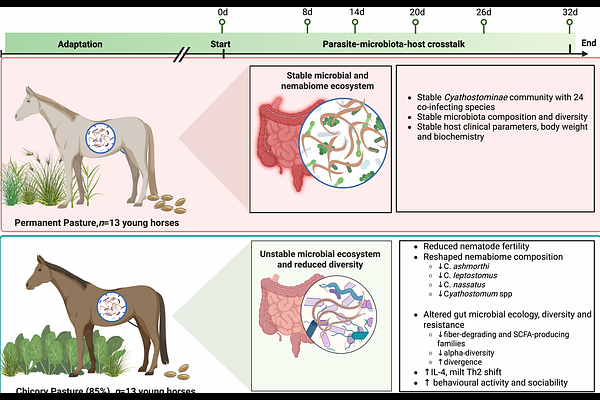
AbstractAnthelmintic resistance in cyathostomins is escalating worldwide, threatening equine health and highlighting the need for sustainable, ecology based parasite control strategies. Chicory (Cichorium intybus, Puna II) has emerged as a promising antiparasitic forage, yet its broader effects on the equine holobiont, parasites, microbiota, and host physiology remain poorly understood. We conducted a 32 day longitudinal grazing trial in young horses to assess how chicory affects parasitological outcomes, gut microbial ecology, nemabiome composition, behaviour, and host physiological and immune responses. Twenty-six naturally infected Anglo-Arabian horses were monitored weekly, with 13 grazing a chicory-based sward and 13 grazing a permanent pasture. Clinical parameters, body weight, and serum biochemistry remained stable across treatments, indicating that chicory was well tolerated. Immune profiles showed limited variation, although IL 10 increased in chicory fed horses, suggesting subtle immune modulation. Behavioural observations revealed no signs of discomfort and indicated slightly enhanced social interactions in the chicory group. Chicory grazing produced a marked reduction in cyathostomin egg excretion, accompanied by species specific shifts in nemabiome composition. Several cyathostomin taxa, including Cylicocyclus ashworthi, C. leptostomus, and C. nassatus, declined in chicory fed horses, whereas certain Cylicostephanus spp increased, indicating differential sensitivity rather than uniform suppression. Concomitantly, chicory induced profound ecological changes in the gut microbiota, including reduced alpha diversity, increased beta dispersion, and destabilised individual microbial trajectories. Several bacterial lineages, particularly Oscillospiraceae, Clostridiaceae, Lachnospiraceae, and Bacteroidales, were differentially enriched, reflecting a functional reorganisation of the intestinal ecosystem. Together, these findings demonstrate that chicory reduces parasite fitness, reshapes nemabiome composition, and alters gut microbial ecology while maintaining host physiological stability. Chicory thus emerges as a promising ecological tool for parasite control, capable of modulating the equine holobiont in ways that complement and potentially reduce reliance on conventional anthelmintic strategies. However, because its effects on gut microbial ecology remain uncertain, and may include shifts resembling dysbiosis, future studies are needed to monitor microbial dynamics more closely and clarify the long term ecological consequences of chicory grazing.