Forecasting tumor growth kinetics and hypoxia levels in mice using mathematical modelling

Forecasting tumor growth kinetics and hypoxia levels in mice using mathematical modelling
Azzopardi, N.; Ternant, D.; Sobilo, J.; Natkunarajah, S.; Lerondel, S.; Roger, S.; Chadet, S.
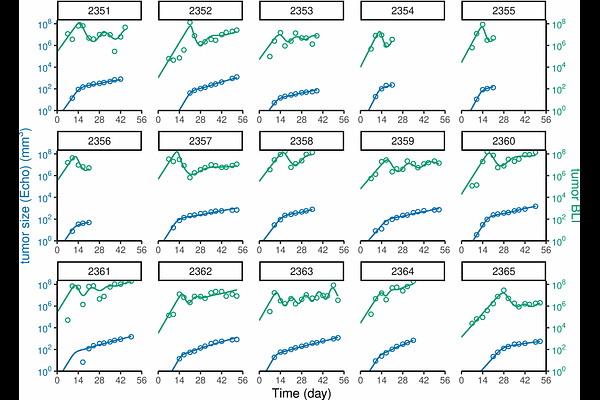
AbstractQuantitative description of tumor growth is challenged by vascular heterogeneity and hypoxia. In this study, mammary tumor growth was investigated in mouse model using caliper and ultrasound imaging measurements, bioluminescence imaging (BLI), and pimonidazole imaging. Tumor volume increased monotonically when assessed by caliper and ultrasound imaging, whereas BLI exhibited oscillating dynamics despite continued tumor growth, consistent with hypoxia-related signal attenuation. A mathematical compartmental model was developed primarily to describe tumor growth dynamics, incorporating latent vascular capacity as a key regulatory variable. The model accounts for reciprocal interactions between tumor expansion and vascular limitation. BLI was integrated as an auxiliary observable to reveal hypoxia-driven modulation of signal production rather than as a direct surrogate of tumor size. Model parameters were estimated using nonlinear mixed-effects modelling with population approach, allowing quantification of population-level behavior and inter-individual variability. The model adequately described tumor growth while explaining BLI dynamics through vascular and hypoxic effects. This framework provides the first semi-mechanistic description of tumor growth and supports the use of BLI as an indirect marker of hypoxia and, consequently, of tumor growth. This model may provide a useful framework for quantifying the effects of vascular-modulating therapeutics and genetic polymorphisms involved in tumor progression.