Differential impact of FLASH and conventional radiotherapy on a pivotal metabolic organ: White Adipose Tissue

Differential impact of FLASH and conventional radiotherapy on a pivotal metabolic organ: White Adipose Tissue
Scabia, G.; Furini, G.; Usai, A.; Asero, G.; Guerra, E.; Mota da Silva, E.; Kusmic, C.; Cavalieri, A.; Del Sarto, D.; Costa, M.; Wabitsch, M.; Rossi, F.; Di Pietro, R.; Lattanzio, S.; Luca, T.; Pezzino, S.; Castorina, S.; Cusano, R.; Capaccioli, S.; Gonnelli, A.; Paiar, F.; Di Martino, F.; Cinti, S.; Maffei, M.
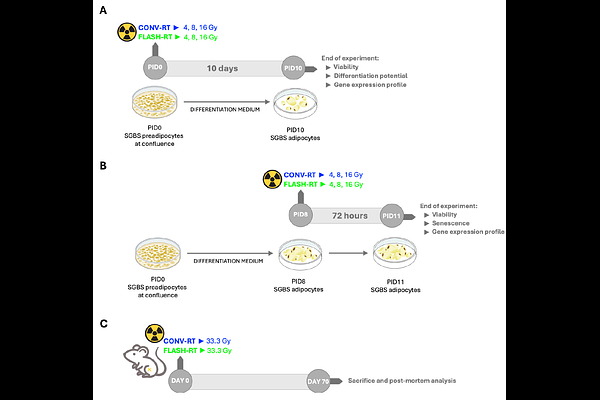
AbstractBACKGROUND: Subcutaneous white adipose tissue (scWAT), a key metabolic and endocrine organ, is inevitably exposed during radiotherapy (RT). While RT is a cornerstone of cancer treatment, its efficacy is limited by toxicity to surrounding healthy tissues. Ultra-high dose rate (FLASH) RT has emerged as a promising modality capable of preserving tumor control while reducing normal tissue damage, the so-called FLASH effect. Clinical evidence indicates that childhood exposure to conventional (CONV) RT is associated with long-term dysmetabolism and WAT dysfunction. However, the impact of FLASH-RT on WAT has not been investigated. AIM: To compare the effects of FLASH- and CONV-RT on adipocyte function and scWAT homeostasis, and to identify molecular and structural changes associated with each modality. METHODS: We evaluated the effects of FLASH- and CONV-RT on adipocytes and scWAT using a dedicated linear accelerator capable of delivering both modalities. Experiments were performed in the human SGBS preadipocyte/adipocyte cell line and in a mouse model subjected to proximal hind limb irradiation, with analyses conducted 70 days post-exposure. RESULTS: RT impaired adipogenic differentiation in a dose-dependent manner, with a relative sparing effect of FLASH at 4-8 Gy. Mature adipocytes exhibited radioresistance, with protection by FLASH at 8 Gy. In vivo, both regimens reduced fat mass without affecting body weight, with greater loss following CONV-RT. Transcriptomic profiling of scWAT revealed inflammatory and neurodegenerative signatures after CONV-RT, whereas FLASH-RT induced minimal transcriptional changes. Histological and ultrastructural analyses confirmed increased cellular damage, vacuolization, lipid spill-over, and reduced PLIN1 expression, predominantly in CONV-treated mice. CONCLUSIONS: WAT homeostasis is sensitive to conventional RT, whereas FLASH-RT better preserves tissue structure and function, with implications for long-term metabolic health in cancer survivors.