Natural selection driven by escape from shifting antibody classes shapes SARS-CoV-2 evolution

Natural selection driven by escape from shifting antibody classes shapes SARS-CoV-2 evolution
Hamilton, C.; Ghafari, M.; Ledda, A.; Lythgoe, K.; Fraser, C.; Ferretti, L.
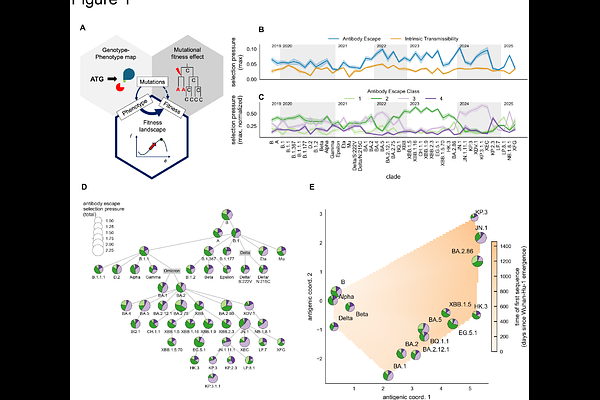
AbstractThe phenotypic fitness landscape defines the action of natural selection on pathogens, linking changes in their phenotypes to transmission and evolution. The rapidly changing nature of epidemic spread and antigenic landscapes pushes viruses to evolve on fitness seascapes. As a result, evolution of viruses such as SARS-CoV-2 proceeds in a never ending series of waves, driven by epistatic interactions and by the arms race between viral adaptation and human immunity. Phenotypic characterisation of these rapidly changing fitness seascapes is an open challenge. Using a Phenotypic Selection Inference framework that links phylogenetic estimates of mutation fitness effects with deep mutational scanning data, we traced how selective pressures on viral phenotypes have shifted throughout the COVID-19 pandemic. Natural selection has favoured enhanced ACE2 binding since the emergence of SARS-COV-2, with relatively constant selective pressure even for the most recent variants. The strength of selection for antibody escape was comparable to ACE2 binding during early evolution, but as population immunity rose, escape from class 3 and then class 2 antibodies became dominant. For variants circulating in 2024, natural selection shifted toward class 3 antibody escape, while those circulating in 2025 have experienced dynamic, rapidly changing pressures for escape from all antibody classes. These transitions reflect an ongoing arms race between viral adaptation and human immunity. Our findings reveal that SARS-CoV-2 antigenic evolution is governed by dynamic, class-specific immune pressures, and that selection for replication capacity has been continuously present during the pandemic, presumably to compensate for the effects of antigenic escape on viral replication. Our approach for the inference of phenotypic selection provides a framework to understand and anticipate the evolution of future variants.