Learnable Graph Network Model (LGNM): A Physics Constrained Graph Neural Network with Quantum Hamiltonian Learning

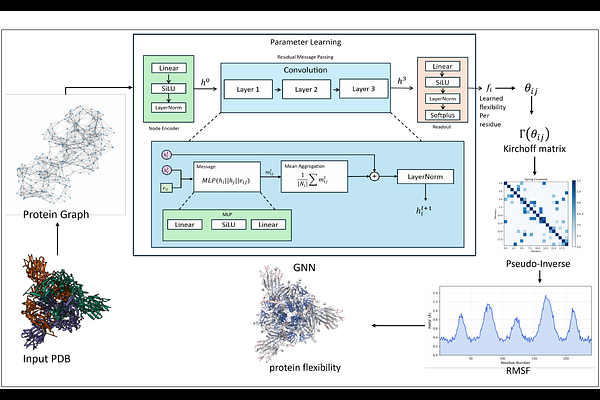
Learnable Graph Network Model (LGNM): A Physics Constrained Graph Neural Network with Quantum Hamiltonian Learning
Sharma, B.; Sarkar, C.
AbstractElastic Network Models (ENMs), particularly the Gaussian Network Model (GNM) and its distance-weighted variant (mENM), predict per-residue protein flexibility from C contact graphs at low computational cost. Their central limitation is the assumption of uniform spring constants, which ignores the chemical identity, burial depth, and evolutionary conservation of individual residue contacts. We introduce the Learnable Graph Network Model (LGNM), a heterogeneous ENM in which per-edge spring constants are parameterised by per-residue flexibility coefficients predicted by a physics-constrained Graph Neural Network (GNN). The GNN is trained on molecular dynamics (MD)-derived root-mean-square fluctuation (RMSF) profiles from 413 proteins in the ATLAS database, using fold-disjoint CATH superfamily splits. The learning objective is an instance of the Quantum Neural PDE (QNPDE) Hamiltonian learning framework, with K = 3 operator types enabling an O(K) quantum gradient. On 91 held-out test proteins, LGNM achieves mean per-protein Pearson correlation r = 0.8549 , versus r = 0.8024 for mENM. The implementation of this methodology is available at https://lgnm.compbiosysnbu.in/ allowing researchers to evaluate flexibility and downstream processes. Keywords: Protein flexibility; Elastic Network Model; Physics-constrained Graph Neural Network; Residue fluctuation.