Convergently-evolved honeypot ants show mixed signs of niche conservatism

Convergently-evolved honeypot ants show mixed signs of niche conservatism
Nogueira, B. R.; Leon-Alvarado, O. D.; Khadempour, L.
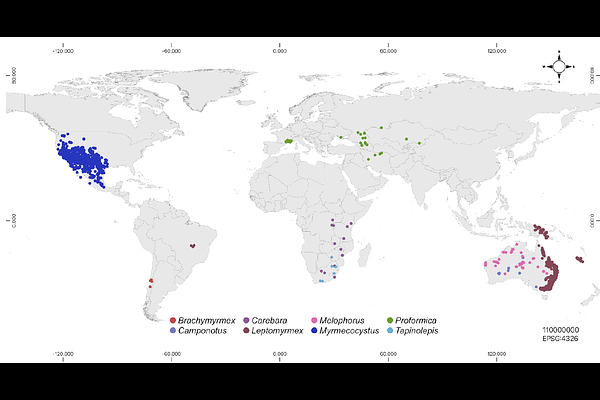
AbstractHoneypot ants represent an example of convergent evolution, where a group of workers specialized in storing liquid food in their crops (i.e., stomach) has independently evolved multiple times across different ant genera. While seasonal resource scarcity and arid conditions are thought to drive the evolution of repletism, the role of environmental variables in this process has not been tested. With this is mind, species ensemble models were computed to assess suitability and richness areas, and the importance of predictors. Predictor importance was compared between genera and groups occupying a similar geographical area. Niche overlap and similarity between honeypot ant species were also evaluated to determine whether they occupy similar environmental spaces. Similarity was mainly found within genera, and Leptomyrmex and Myrmecocystus showed striking niche differences. Overall, Leptomyrmex distribution was mainly influenced by atmospheric bioclimatic variables like precipitation and temperature, while Myrmecocystus had soil bioclimatic variables as the most important predictors for their current distribution. Our results indicate that honeypot ants species currently do not occupy the same environmental space, and are not experiencing the same contemporary environmental stressors. While our results suggest that contemporary environmental factors cannot explain the convergence of honeypot ants, future research will examine past climatic conditions along with investigations into the ant genomes to understand more about the causes and consequences of the convergence.