Genome-wide divergence in a desert plant in the Baja California Peninsula driven by glacial cycles and adaptation to different climatic conditions

Genome-wide divergence in a desert plant in the Baja California Peninsula driven by glacial cycles and adaptation to different climatic conditions
Andreev, V.; Araya-Donoso, R.; Baty, S. M.; Wilder, B. T.; Lira-Noriega, A.; Moore, D. G.; Culver, M.; Dolby, G. A.; Munguia-Vega, A.
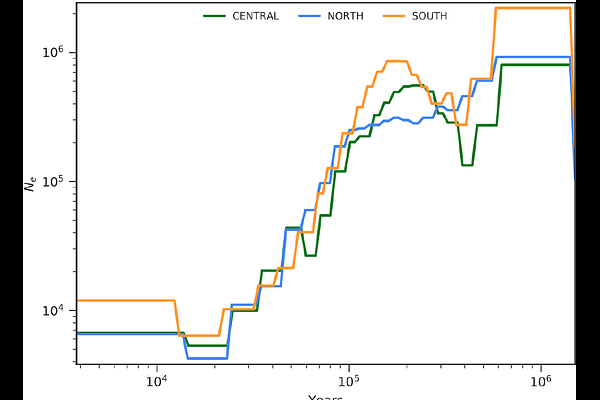
AbstractThe processes that generate distinct patterns of population subdivision (i.e., phylogeographic breaks) and facilitate local adaptations continue to be a focal point of evolutionary research. Here, we used whole-genome sequencing, demographic modeling, ecological niche modeling, and genotype-environment association analysis paired with outlier tests to understand patterns and drivers of diversification of the desert shrub Encelia farinosa in the Baja California Peninsula. We found that E. farinosa was represented by three moderately differentiated (0.027 < Fst < 0.068) genetically distinct groups, distributed across the North, Central and Southern regions of the Peninsula. Demographic analyses revealed fluctuations in the effective population sizes and two lineage divergence events, which coincided with the onset of recent glacial cycles. The ecological niche modeling recovered concordant southward shifts and decrease in the suitable habitat for all E. farinosa groups during the Last Glacial period. Analyses of associations between putative adaptive loci and environmental variables suggested that climate has been an important driver of adaptive genetic variation, with regional differentiation primarily associated with solar irradiation, temperature, and precipitation seasonality. We demonstrate that local adaptations in E. farinosa involve multiple genes associated with immune response, stress response, and morphological adaptations associated with arid climate such as leaf pubescence. Our findings indicate that current levels of differentiation and genetic variation in E. farinosa can be explained by the interplay of processes acting at multiple temporal scales, including isolation by distance, glaciation-mediated demographic processes, and recent natural selection shaping specific adaptations for each geographical group.