Widespread introgression and a potential role for a neo-sex chromosome in booby diversification and speciation

Widespread introgression and a potential role for a neo-sex chromosome in booby diversification and speciation
Jackson, D.; Funk, E.; Abueg, L. A. L.; Anderson, D. J.; Balacco, J.; Formenti, G.; Friesen, V. L.; Jain, N.; Mathers, T. C.; Morris-Pocock, J.; Sollitto, M.; Steeves, T.; Tilley, T.; Vertebrate Genomes Project Consortium Phase 1, ; Wilson, M.; Zavalaga, C.; Taylor, S. A.
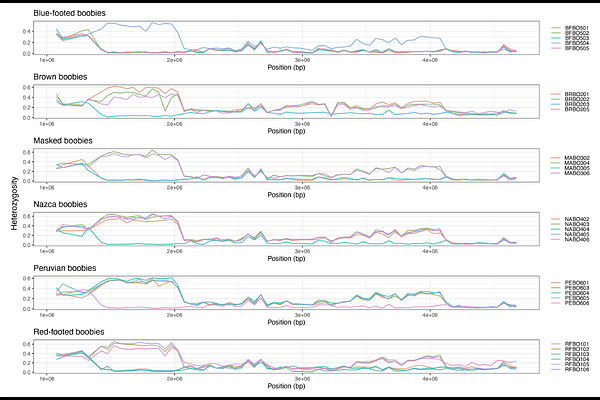
AbstractSpeciation in marine taxa is dynamic and complex, often occurring in the absence of absolute geographic barriers to gene flow. Boobies comprise a clade of seven highly mobile seabird species with high diversity in the eastern Pacific Ocean, where no land barriers separate extant sister species and hybridization is widespread. They exhibit striking diversity in bare-part coloration, an important signal of mate quality, and possess a novel multiple sex chromosome system (Z1Z2Z1Z2 / Z1Z2W), likely resulting from a fusion between an ancestral autosomal microchromosome and the W chromosome. To understand speciation processes in the context of gene flow, we sequenced and analyzed 29 short-read booby genomes and assembled a reference northern gannet genome to (1) test for introgression, (2) characterize genomic patterns of divergence across species, and (3) investigate the gene content and evolution of the neo-sex chromosome. We found that divergence among eastern Pacific sister taxa is temporally associated with periods of glacial maxima. Between periods of glacial maxima, two pairs of sister species (blue-footed and Peruvian boobies; masked and Nazca boobies) exhibit strong signatures of episodic introgression, indicating that speciation has occurred over multiple periods of divergence followed by gene flow. However, in the third pair of sister species, genomic signatures showed higher divergence within brown booby populations than between brown and Cocos boobies. We also identified the epidermal differentiation complex -- a gene cassette involved in skin, feather, beak, and claw development -- on the neo-sex region of the W chromosome, where it spans the boundary between the putatively recombining and non-recombining regions, with interspecific variation in the exact recombination suppression boundary. We inferred that this complex may contribute to diversity in feather and bare part coloration across boobies. Together, these results reveal that diversification and speciation in a clade of highly mobile seabirds emerged from a complex evolutionary history involving historical climate dynamics, introgression, and sex chromosome evolution.