From prehistory to present-day: How isolation shaped the distinct genomic makeup of Italian Alpine valleys

From prehistory to present-day: How isolation shaped the distinct genomic makeup of Italian Alpine valleys
Villani, G.; Rambaldi Migliore, N.; Tommasi, A.; Nannini, N.; Partel, E.; Cerizza, V.; Piloni, I.; Sorasio, G.; Nicolini, V.; Cardinali, I.; Di Gerlando, R.; Bozzari, G.; Raimondi, E.; Riccadonna, D.; Raffaeta', R.; Hauffe, H. C.; Colli, L.; Olivieri, A.; Salas, A.; Lancioni, H.; Fedrigotti, A.; Ajmone Marsan, P.; Torroni, A.; Achilli, A.
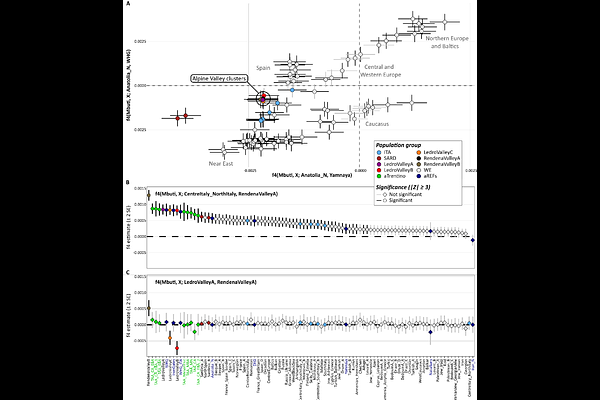
AbstractHistorically, the eastern Italian Alps have provided crucial geographic corridors for cultural and genetic exchange between the Mediterranean region and Central and Northern Europe. Although recent archaeogenomic data suggest a strong regional persistence of Anatolian Neolithic ancestry followed by the arrival of Yamnaya-related components during the Bronze Age, the genomic landscape of modern Alpine populations remains largely unmapped. In this study, we verified the persistence of these signals in the present-day Rendena and Ledro Valleys by integrating novel complete mitochondrial genomes (N=185) and genome-wide SNP data (N=96), the latter combined with a novel Italian genomic dataset (N=139). Our findings show that the Rendena and Ledro populations form a distinct "modern Alpine" genomic group, which retains a significant proportion of early European Neolithic ancestry, aligning with ancient eastern Italian Alpine individuals and modern Sardinians. More recently, geographic isolation and localized genetic drift appear to have shaped the two valleys differently. Demographic reconstructions reveal asynchronous population declines over the past two millennia, followed by a sharp, synchronized bottleneck 200-300 years ago, which coincided with historical plague outbreaks. Remarkably, this structured drift persisted at an extremely fine microgeographic scale within the valleys, resulting in internal genetic subclusters that directly correlate with local topography. This micro-differentiation was likely maintained by steep geographic barriers and/or local endogamous practices. This study ultimately underscores how geographic barriers and isolation can preserve ancient genomic components and shape highly localized genetic structures over centuries even to the modern day.